
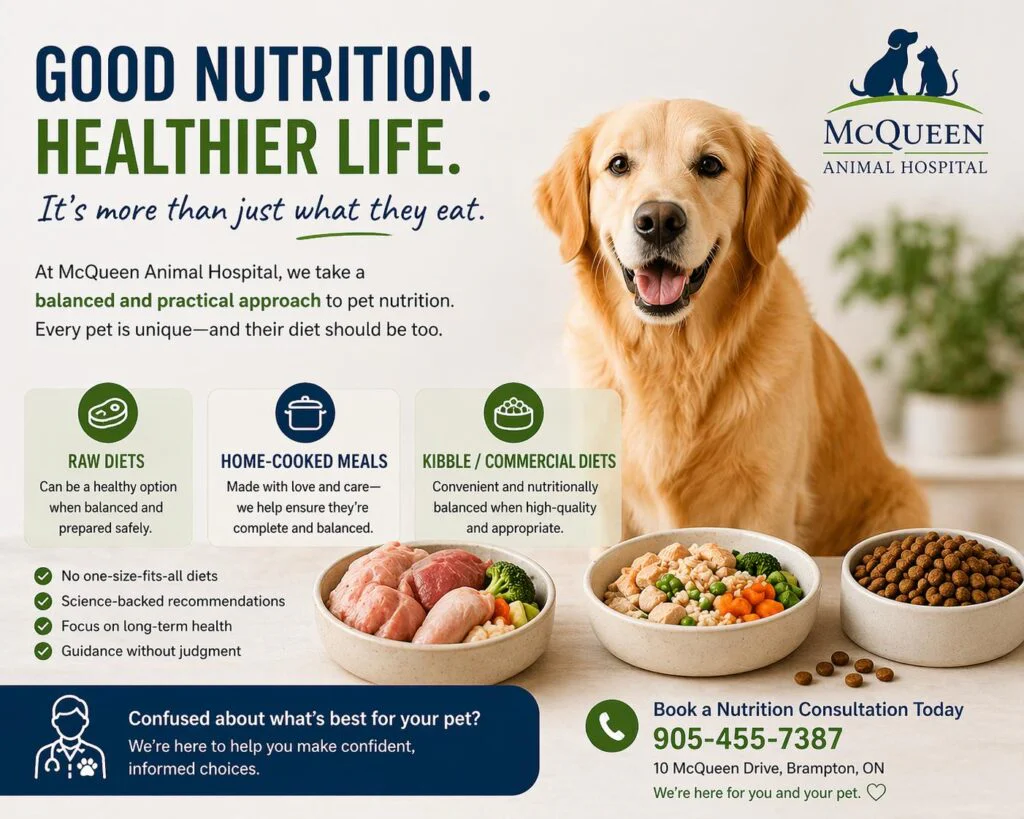
At McQueen Animal Hospital in Brampton, one of the most common questions we hear is:
“What is the best diet for my dog or cat?”
With so much information online—raw diets, home-cooked meals, grain-free foods, supplements—it’s completely understandable to feel unsure.
This guide is designed to simplify pet nutrition so you can make confident decisions—without feeling judged or overwhelmed.
Why Nutrition Matters More Than Most People Realize
What your pet eats every day affects:
- Skin and coat health
- Digestive system
- Weight and metabolism
- Energy levels
- Immune function
- Long-term disease risk
Many common issues—like itching, recurrent ear infections, and digestive problems—are often influenced by diet.
We Understand Different Feeding Approaches
Today, many pet owners are exploring raw diets, home-cooked meals, and “natural” feeding approaches.
Wanting to feed your pet fresh or natural food is a reflection of how much you care about their health.
Our goal is to help you understand the benefits and potential risks, ensure your pet’s diet is safe and nutritionally complete, and work with you—not against you.
If you are already feeding a home-prepared or raw diet, we’re happy to review it and help you make it safer and more balanced.
Common Myths About Pet Nutrition (Explained Gently)
Myth: Dogs in the wild eat raw food, so raw must be best
It’s true—wild dogs and wolves eat raw food. However, their lifestyle is very different from that of our pets. Wild animals face parasites, infections, and injuries and often have shorter lifespans. Our goal is long-term health and quality of life in a home environment.
Myth: Raw diets lead to better growth and stronger dogs
Healthy growth depends on precise nutrient balance, including calcium–phosphorus ratio, vitamins, minerals, and controlled calories. Unbalanced diets can lead to bone and joint problems, especially in puppies.
Myth: Commercial pet food is full of fillers and low-quality ingredients
The term “fillers” is often misunderstood. Many such ingredients provide energy, fiber, and digestive support. What matters most is whether the diet is complete, balanced, and consistent over time.
Myth: Processed food causes cancer, so it must be harmful for pets too
Human and pet nutrition are not directly comparable. Properly formulated pet foods are designed to provide complete nutrition, and there is no strong evidence linking balanced commercial diets to cancer in pets.
Myth: If my diet is healthy, it should be fine for my dog
Dogs have different nutritional requirements. A healthy human diet may still be incomplete for a dog without careful formulation.
Myth: Cleaning raw meat with vinegar makes it safe
Vinegar may reduce some surface bacteria but does not reliably eliminate harmful pathogens like Salmonella or E. coli.
Myth: A shiny coat means the diet is perfect
A shiny coat is often influenced by fat intake. It is a positive sign but does not guarantee complete nutritional balance internally.
Frequently Asked Questions About Pet Diets
What is the best diet for my dog or cat?
There is no single perfect diet. The best diet is balanced, safe, and tailored to your pet’s age, breed, and health.
How do I know if my pet’s diet is working?
Look for a healthy weight, consistent stools, good energy, and healthy skin and coat. Some issues may not be obvious early on.
Can diet help with skin problems or ear infections?
Yes. Nutrition plays a major role in skin health, inflammation, and immune function. Many pets improve when diet is adjusted.
Are grain-free diets better?
Not necessarily. Diet choice should be based on your pet’s individual needs, not trends.
Can I mix kibble with home food or raw food?
It can be done carefully. Random mixing may create imbalance or digestive issues.
I cook meat and rotate different meats. Is that enough?
Cooking improves safety, but diets may still lack calcium, trace minerals, and essential vitamins.
I give bones and supplements. Is that enough?
These help, but complete nutrition requires correct amounts, proper ratios, and consistency.
Does cooking destroy nutrients?
Some nutrients are affected by heat, but properly formulated diets compensate for this.
Do pets need supplements?
Not always. Many pets on balanced diets do not require additional supplements.
What are common feeding mistakes?
Overfeeding, too many treats, unbalanced home diets, and mixing foods without guidance.
Do I need a nutrition consultation?
If you’re unsure or your pet has ongoing issues, guidance can help simplify feeding decisions.
Our Approach to Pet Nutrition
- Nutrition should be evidence-based
- “Natural” does not always mean safe
- Balance matters more than trends
- Every pet deserves a complete and consistent diet
We’re here to guide—not to judge.
Book a Nutrition Consultation
If you’re unsure what to feed your pet—or just want reassurance—you don’t have to figure it out alone.
Call 905-455-7387
McQueen Animal Hospital, Brampton, Ontario