
As a pet parent, hearing that your dog or cat needs surgery can be a stressful experience. Whether it is a routine spay or neuter or a complex, life-saving operation, the word “anesthesia” often brings up feelings of anxiety. It is natural to worry about your beloved family member when they are not awake to tell you how they feel.
At McQueen Animal Hospital, we understand these concerns deeply. When it comes to pet anesthesia in Brampton, our priority is not just completing the surgery, but ensuring a smooth, uneventful recovery. Two of the most critical “hidden” factors in that safety mission are Blood Pressure and SPO2 (Oxygen Saturation).
While they might sound like technical medical jargon, they are the vital lifelines we watch every single second to keep your pet safe.
Understanding Anesthesia: More Than Just Going to Sleep
Many people think anesthesia is simply just “going to sleep.” In reality, it is a controlled state of unconsciousness where muscles relax and reflexes disappear. Because the body is in such a deep state of rest, the internal systems that usually run on autopilot need a little bit of help.
This is where monitoring comes in. Just like a pilot watches their controls during a flight, our veterinary team watches your pet’s vital signs. We don’t just look at them occasionally; we track them constantly. This allows us to react the moment something changes, ensuring your pet stays stable from start to finish.
Why Blood Pressure Monitoring is Non-Negotiable
One of the most common and inevitable side effects of anesthetic drugs is a drop in blood pressure. In the medical world, we call this hypotension. While a slight dip is expected, a significant drop can be dangerous if not corrected immediately.
Protecting the Vital Organs
Blood pressure is essentially the force that “pushes” blood through the body. Why does this matter? Because that blood carries life-sustaining oxygen to your pet’s internal organs.
The kidneys, in particular, are incredibly sensitive to changes in blood pressure. If the pressure stays too low for too long, it can cause permanent damage to these organs. This is scary because kidney damage might not show up on blood tests until days or weeks after the surgery is over.
By monitoring blood pressure, we ensure that the “delivery truck” keeps moving. We make sure every organ, from the brain to the kidneys, gets the fuel it needs to function correctly.
Real-Time Correction
When you choose McQueen Animal Hospital for pet anesthesia in Brampton, we don’t just “hope” for the best. We monitor blood pressure constantly. If our industry-leading monitors detect a dip, our team is ready to act instantly.
We don’t just watch the number go down; we fix it. We can take several steps to bring the pressure back up, such as:
- Adjusting the depth of anesthesia.
- Increasing intravenous (IV) fluid rates to “plump up” the blood vessels.
- Administering supportive medications to help the heart pump stronger.
This proactive approach ensures your pet’s organs remain healthy and functional throughout the procedure.
Understanding SPO2: The Oxygen Lifeline
If blood pressure is the “delivery truck” that moves things through the body, SPO2 is the “cargo.” SPO2 is a measurement of how much oxygen is actually dissolved in your pet’s blood and carried by their red blood cells.
Why SPO2 Drops
During anesthesia, a pet’s breathing pattern changes. They breathe slower and shallower than they do when they are awake. Many factors can impact their oxygen levels, including:
- Pre-existing lung or heart conditions.
- The position of the pet during surgery.
- An obstructed airway.
- Individual reactions to anesthetic drugs.
If the SPO2 level drops, it means the blood is not picking up enough oxygen from the lungs. This is dangerous because the brain and heart can survive only for a very short time without oxygen.
How We Keep Oxygen Levels Safe
By monitoring SPO2, our Registered Veterinary Technicians (RVTs) can ensure that your pet’s brain, heart, and tissues are receiving 100% of the oxygen they need to survive and heal.
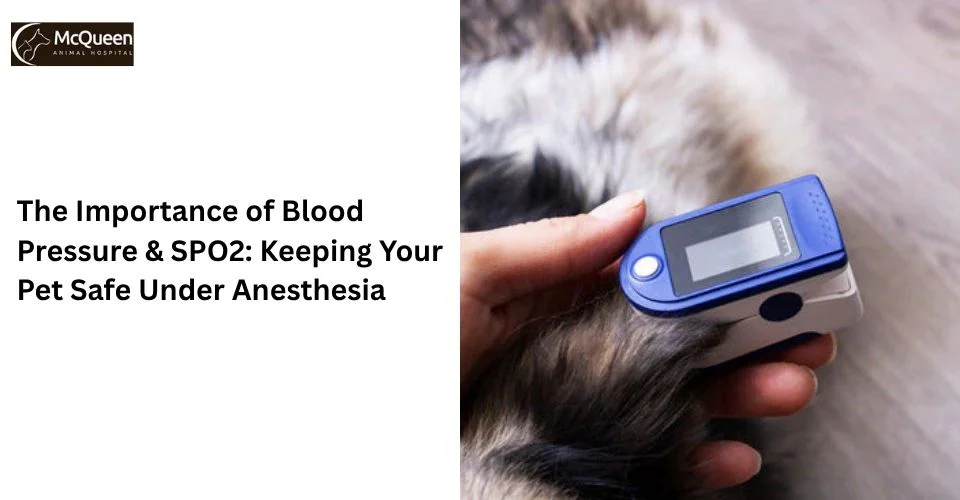
The monitor clips onto a non-pigmented area of the body, usually the tongue or ear, and uses light to measure oxygen saturation. If the oxygen saturation level starts to trend downward, we can immediately adjust the oxygen flow or assist the pet’s breathing manually to stabilize them. This immediate response is key to preventing complications.
The Power of the Registered Veterinary Technician (RVT)
Technology is amazing, but it is only as good as the person reading it. At McQueen Animal Hospital, your pet is never left alone with just a machine.
From the moment sedation begins until your pet is consciously standing in their recovery kennel, an RVT is by their side. This is a standard we refuse to compromise on.
Training You Can Trust
Our technicians undergo hundreds of hours of training specifically dedicated to pet anesthesia in Brampton. They don’t just learn how to read a screen; they learn to understand the physiology of your pet.
While the monitor measures over ten parameters every second, the technician provides the “human touch.” They watch the monitor, listen to the heart, and feel the pulses. They ensure that the data on the screen matches the physical state of your pet.
This dual-layer of protection—advanced technology plus expert human eyes—is what makes our anesthetic protocols so reliable. We catch things machines might miss, ensuring the highest level of safety for your dog or cat.
A Closer Look at Other Vital Signs
While blood pressure and SPO2 are stars of the show, they aren’t the only things we watch. A safe anesthetic plan relies on a full picture of health.
Here are a few other parameters we monitor every second:
ECG (Electrocardiogram):
You have likely seen these wavy lines on TV shows. They give us important information on heart function. An ECG can detect potentially fatal arrhythmias (irregular heartbeats) in real time, allowing for accurate and rapid treatment.
Capnography (CO2 Monitoring):
This tells us if the patient is breathing adequately. It measures the carbon dioxide they breathe out. It is the most accurate tool we have for assessing heart function under anesthesia.
Temperature:
Lowered core temperature is an inevitable effect of anesthesia. A cold pet recovers slowly and is at higher risk for infection. We use safe supplemental heat sources, like our Bair Hugger which uses forced warm air, to surround your pet and maintain their body temperature.
Recovery: The Final Step in Safety
A safe procedure doesn’t end when the last stitch is placed. Monitoring blood pressure and SPO2 is just as vital during the “wake-up” phase. In fact, this is often the most critical time.
As the anesthesia drugs wear off, the body has to take over the work again. This transition can be bumpy. Pets with stable vitals during surgery tend to have much smoother recoveries. They wake up faster, experience less confusion, and their bodies are better prepared to begin the healing process.
By maintaining steady vitals right up until they go home, we reduce the risk of postoperative infections and other complications. This ensures that your pet can return to their happy, playful self as soon as possible.
Why Choose McQueen Animal Hospital for Your Pet’s Surgery
Choosing the right veterinary team for a procedure is a big decision. You want a team that sees your pet as more than just a patient.
At McQueen Animal Hospital, we are founded entirely on the notion of providing the Brampton and Mississauga community with friendly, high-quality, and affordable care. We know your pets are family, and we strive to treat them as such.
We endeavor to play an important role in your pet’s life, ensuring their health and well-being. We are honoured to have this responsibility. To ensure we offer the best, we commit hundreds of hours annually to improve our professional knowledge.
We proudly provide the best services in Brampton and the surrounding community, including Mississauga, Georgetown, and Milton. When you are with us, you are part of our family. We uphold excellence through advanced treatments, integrity in our practices, and a dedication to innovation in veterinary medicine.
Educating pet owners is at the heart of what we do. We want you to feel informed and confident in the decisions you make. If you have questions about our protocols, we are always happy to answer them.
Conclusion:
Your pet’s safety is our number one goal. From the initial blood work to the final recovery snuggles, we are there. By combining advanced monitoring of blood pressure and SPO2 with the compassionate care of our RVTs, we provide a safety net that allows your pet to undergo necessary procedures with minimal risk. We are committed to ensuring that every experience with pet anesthesia in Brampton is uneventful, resulting in a smooth return to health.
Are you planning a surgery for your pet? Contact us today to learn more about our comprehensive safety protocols. Let us give your beloved companion the expert care they deserve.