
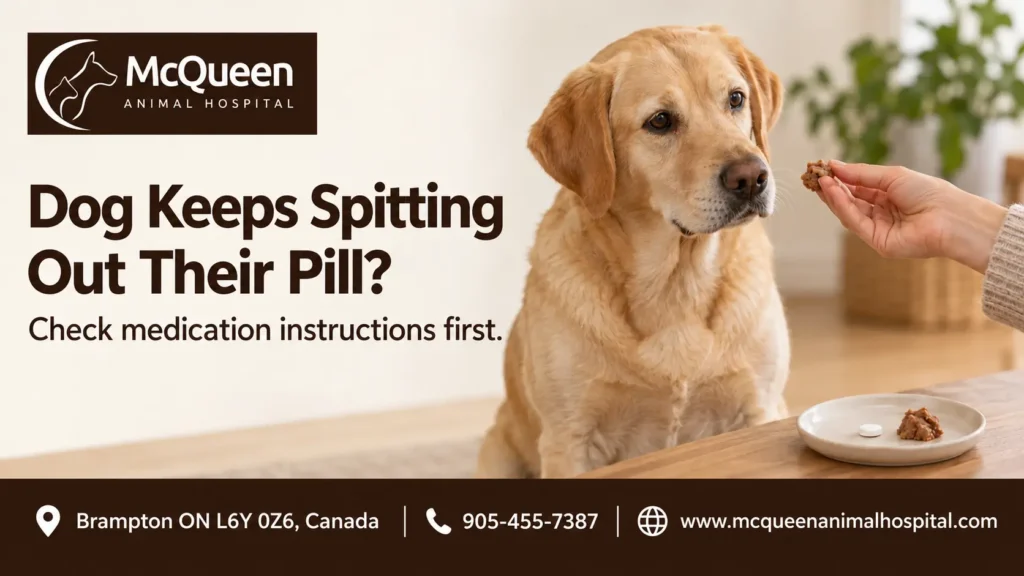
The first step in giving a dog a pill is to check how that specific medicine may be given. Read the prescription label and accompanying instructions, then ask the prescribing team if anything is unclear. Food, crushing tablets, opening capsules or switching formulations may not be suitable for every prescription. Once you know what is allowed, choose an approach your dog can accept calmly—and avoid giving another dose if you are unsure how much they swallowed.
Check the medicine’s instructions before hiding it
A tablet tucked into food may seem like an easy solution, but some medicines need an empty stomach, while others should be given with food. Check whether “with food” means a small bite is sufficient or whether the medicine should accompany a meal. If fasting is required, ask for the exact timing rather than guessing.
Do not assume that making the pill smaller will solve the problem. The FDA’s advice on preventing veterinary medication errors warns against cutting, crushing or breaking tablets or capsules unless the veterinarian has instructed you to do so. Opening a capsule also needs approval for that particular product. Changing a formulation can affect how it works or expose a bitter taste that makes your dog less willing to take it.
Before the next attempt, confirm:
- Whether the medicine can be given with food, and which foods are suitable.
- Whether the tablet must remain whole or the capsule must remain closed.
- Whether your dog’s allergies, prescribed diet or health conditions restrict the food used.
- What to do if the pill is spat out, partly eaten or vomited.
Dietary restrictions apply to pill coverings too. If your dog is undergoing a food elimination trial, check with the treating team before using a flavoured pill treat or food outside the approved diet.
If food is allowed, use a small, suitable bite
When the prescribing team confirms that food is appropriate, ask whether a little of your dog’s usual soft food or a suitable mouldable pill treat would work. Use only enough to enclose the pill. A large lump gives some dogs room to eat around the tablet, while mixing medication into a whole meal makes it difficult to know how much they received if they leave food behind.
Choose a quiet place away from other pets and let your dog approach willingly. You can offer a small, unmedicated piece first. If they eat comfortably, offer the pill-containing piece, followed by another plain piece once they have swallowed. Keep the pace relaxed; the aim is willing eating, not gulping.
Cornell University’s guidance on medicating dogs recommends small food portions and watching to ensure the medication is swallowed, because some dogs eat the covering and spit out the pill. Observe your dog afterwards and check the feeding area for a dropped tablet without reaching into their mouth.
If your dog refuses the plain food too, stop treating this as a pill-hiding problem. Tell the prescribing team that your dog is also unwilling to eat, particularly if this is a new change. Our article on loss of appetite in dogs explains why refusing food and wanting to eat but struggling to do so are different concerns.
Avoid turning each dose into repeated failed attempts
A dog that bites into a bitter tablet may become suspicious of the food used to hide it. Chasing, cornering or repeatedly handling their mouth can add fear to that association. The next attempt may then become harder before the medicine even appears.
Prepare everything before approaching your dog, keep your movements unhurried and offer calm praise for willing participation. Where the medication and diet allow, offering the same approved food without medicine at other times may help preserve its value as a reward. The principles behind reward-based training rather than punishment are useful here: encourage cooperation without escalating pressure.
If your dog backs away, freezes, growls, snaps or struggles, stop the attempt and contact the prescribing team promptly for a workable plan. Do not punish a warning growl, pin your dog down or force their jaws open. A method that depends on overcoming resistance is not a safe solution for giving tablets at home.
If you are unsure whether the dose was swallowed
Do not automatically give another pill or try to replace an estimated missing portion. A tablet may have been partly swallowed, dissolved or chewed, and looking at the remaining pieces cannot reliably tell you how much medicine your dog received.
Record the medicine’s name and strength, the scheduled dose, the time of the attempt and what you observed. Explain whether you found an apparently whole tablet, fragments, medicated food left behind or vomit. Keep any recovered medicine away from children and other animals, and ask the prescribing team whether it should be discarded.
The FDA’s pet medication guidance explains that what to do after spitting out or vomiting medicine depends on the drug; giving another dose can sometimes result in too much being absorbed. Ask for instructions for both the uncertain dose and the next scheduled one. If you may already have given an extra dose, contact a veterinarian immediately.
A shared medication record can also prevent confusion between household members. Write “uncertain—awaiting advice” when appropriate, rather than marking a dose as successfully given.
Ask the prescribing team to demonstrate a suitable method
When your dog keeps spitting out medication, explain exactly where the attempt fails: they refuse the food, eat around the pill, spit it out afterwards or resist having their face touched. That detail helps the team choose a practical next step.
Ask the prescribing clinic for an administration demonstration suited to your dog and the medicine. If McQueen Animal Hospital is your dog’s vet clinic, you can discuss the difficulty with its team; if another practice prescribed the medicine, contact that prescribing team first.
Direct administration or a pill-giving device may be appropriate for some dogs, but ask for hands-on instruction before trying either. A device does not remove the risk of injury or make restraint safe when a dog is frightened.
You can also ask whether the same prescribed medicine has a suitable alternative formulation. Some medicines may be available in another form, but not every prescription has a liquid, flavoured or compounded option. A liquid is not automatically easier for a dog that dislikes mouth handling. Any change needs the veterinarian’s approval and its own clear administration instructions.
Stop if swallowing seems difficult
Spitting out a hidden tablet is different from struggling to swallow. Stop oral administration and seek prompt veterinary advice if your dog repeatedly coughs or gags during attempts, drools unusually, appears painful when swallowing or also struggles with food or water. A veterinary examination may be needed to investigate the difficulty. Do not try to wash the pill down by squirting water into their mouth.
Breathing difficulty, suspected choking or collapse requires immediate emergency veterinary care. Do not continue trying to give medication.
For ongoing pill refusal, contact the prescribing team before further doses become uncertain. Have the labelled medicine and a brief record of your attempts ready so they can help you find a method that follows the prescription and is manageable for your dog.