
Medically reviewed by Dr. Harinder Babbar, DVM
Veterinarian & Medical Director, McQueen Animal Hospital, Brampton, OntarioThis article has been medically reviewed and is based on current evidence-based veterinary literature and clinical guidance.
Persistent bad breath in dogs is most commonly linked to dental or gum disease, but it is not always a dental problem. A broken or infected tooth, something trapped in the mouth, an oral growth, or inflammation of the mouth can also cause a strong odour. Less commonly, conditions such as kidney disease or diabetes may change a dog’s breath, especially when other symptoms appear at the same time.
If bad breath is the only change and your dog is eating, drinking, and behaving normally, it usually does not require emergency care. However, breath that stays unusually foul, becomes progressively worse, or appears with difficulty eating, facial swelling, vomiting, weight loss, increased thirst or urination, or weakness should be assessed by a veterinarian.
The smell itself cannot diagnose the problem. The more useful clues are how long it has been present, whether it started suddenly, what is happening inside the mouth, and what else has changed in your dog’s health.
Is Bad Breath in Dogs Normal?
A dog’s breath does not need to smell fresh, so an occasional unpleasant odour does not automatically indicate disease. If your dog has just eaten strongly scented food, scavenged outdoors, or gotten into something unpleasant, the smell may disappear fairly quickly.
Persistent bad breath is different.
When the odour remains day after day, repeatedly returns, or becomes stronger over time, there is usually an underlying reason worth investigating. Dental disease is often responsible, particularly when tartar, gum inflammation, or changes in chewing are also present.
Some dogs with significant oral disease continue eating normally, which can make the problem easy to underestimate. Others make subtle adjustments instead of refusing food completely. They may chew on one side of the mouth, take longer to finish meals, stop taking hard treats, or swallow kibble with less chewing.
If you are noticing these changes, McQueen’s guide to the signs your dog may need dental cleaning explains other dental changes that can accompany worsening oral disease.
What Causes Persistent Bad Breath in Dogs?
The mouth is the first place veterinarians usually investigate because most persistent halitosis originates there. That does not mean every case has the same cause.
Periodontal Disease and Gum Inflammation
Periodontal disease develops in the tissues surrounding and supporting the teeth. Plaque accumulates along and beneath the gumline, inflammation progresses, and the supporting structures around a tooth may eventually become damaged.
Bad breath can appear early, but the amount of smell does not reliably tell you how severe the disease is.
A dog with periodontal disease may also develop red or bleeding gums, visible tartar, gum recession, loose teeth, discomfort when chewing, or changes in eating behaviour. Some dogs show very few outward signs despite disease beneath the gums.
For dogs with suspected oral disease, a veterinary examination can determine whether pet dental care in Brampton is appropriate and whether the problem extends beyond routine plaque accumulation.
Why Visible Tartar Does Not Tell the Whole Story
Owners naturally judge dental health by looking at the visible surface of the teeth. The difficulty is that a large portion of every tooth and its supporting structures lies below the gumline.
A tooth can therefore look relatively normal above the gum while inflammation, bone loss, root disease, or another problem is developing underneath.
The opposite can also occur. A tooth may have noticeable surface tartar without being the main source of a dog’s discomfort.
This is why veterinary dental assessment involves more than deciding how dirty the teeth look.
A Broken or Infected Tooth
A damaged tooth can produce persistent bad breath even when the rest of the mouth appears relatively clean.
Dogs can fracture teeth while chewing bones, antlers, very hard toys, or other rigid objects. Trauma can also damage a tooth. If the protective outer structure is compromised deeply enough, the tissues inside the tooth can become inflamed or infected.
The signs are not always dramatic. You may notice that your dog suddenly avoids hard treats, chews on one side, drops food, resists having the face touched, or develops swelling around the muzzle or below an eye.
An infected tooth can become painful long before a dog stops eating altogether.
McQueen’s article on the common signs of a dog tooth infection covers these changes in greater detail.
Something Stuck in the Mouth
A sudden change in breath can occasionally be caused by material lodged inside the mouth rather than disease of the teeth themselves.
Dogs commonly chew sticks, plant material, bones, toys, and objects they find outdoors. A fragment can become wedged between teeth, around the gums, against the roof of the mouth, or beneath the tongue. Food and bacteria may then collect around the area while the surrounding tissue becomes irritated.
A dog with an oral foreign body may drool excessively, paw at the mouth, repeatedly swallow, gag, chew differently, or suddenly resist having the mouth handled.
Do not force open the mouth of a dog that appears painful. Reaching deeply into the mouth can lead to a bite, and some objects should not be pulled until a veterinarian can determine where they are lodged.
Oral Growths, Ulcers, and Abnormal Tissue
An oral growth is much less common than periodontal disease, but persistent unexplained bad breath is one reason abnormal tissue inside the mouth should not be ignored.
Growths can develop on the gums, tongue, jaw, palate, or other oral tissues. Some are benign and others are malignant. Their appearance alone does not always reveal which type is present.
Bad breath may become noticeable if abnormal tissue ulcerates, bleeds, becomes infected, or traps food and debris. Other possible signs include excessive saliva, blood around the mouth, loose teeth, difficulty chewing, facial asymmetry, or an area that does not heal.
The back of a dog’s mouth is difficult to inspect properly at home, so not every abnormality will be visible simply by lifting the lip.
When Bad Breath May Be Coming From Outside the Mouth
If the oral examination does not adequately explain the smell, or the dog has changes elsewhere in the body, the veterinarian may consider causes beyond the teeth and gums.
This is where accompanying symptoms become particularly important.
Kidney Disease
Kidney disease can affect a dog’s breath when kidney function becomes significantly impaired and waste products are no longer being removed from the body normally.
The breath change would not usually occur in isolation. Depending on the stage and type of kidney disease, a dog may also drink more, urinate more, lose weight, eat less, vomit, become dehydrated, or appear unusually tired.
With more advanced disease, changes and ulceration inside the mouth may also occur.
Bad breath and increased thirst do not automatically mean kidney disease. There are several reasons dogs may drink more water. The combination does, however, give the veterinarian a reason to investigate beyond dental disease.
Diabetes and Changes in Breath
Diabetes is another condition that can occasionally change the smell of a dog’s breath, but the more important signs are usually happening elsewhere.
Dogs with diabetes commonly drink more, urinate more, and lose weight. Some initially continue eating well or even appear hungrier than usual.
A much more serious situation develops when diabetes becomes complicated by diabetic ketoacidosis. Dogs affected by diabetic ketoacidosis are typically ill rather than simply having unusual breath. Vomiting, poor appetite, dehydration, weakness, and marked lethargy may occur. Diabetic ketoacidosis is a life-threatening complication requiring veterinary treatment.
Trying to identify diabetes by deciding whether the breath smells “sweet” is therefore not reliable. The dog’s thirst, urination, weight, appetite, and overall condition provide much more useful information.
Liver, Nasal, Throat, or Digestive Problems
Bad breath can occasionally originate from conditions involving areas other than the mouth.
Persistent nasal disease, problems involving the throat or oesophagus, repeated regurgitation, and some gastrointestinal or liver disorders may contribute to unusual breath. These causes usually become more relevant when another symptom is present.
For example, persistent one-sided nasal discharge changes the clinical picture. So does frequent regurgitation, repeated vomiting, difficulty swallowing, jaundice, or unexplained weight loss.
These are not conditions an owner should try to separate by smell. They are reasons to tell the veterinarian about symptoms that may initially seem unrelated to the breath.
What Other Symptoms Matter When Your Dog Has Bad Breath?
The presence of bad breath tells you relatively little about urgency on its own. The symptoms occurring with it are more important.
Bad Breath With Difficulty Eating, Drooling, or Mouth Pain
When bad breath occurs with obvious changes in the mouth or eating behaviour, oral disease moves higher on the list of possibilities.
Watch how your dog eats rather than simply checking whether the bowl eventually becomes empty. A dog with dental pain may still finish a meal but eat more slowly, move food to one side, hesitate before picking it up, or stop chewing harder items.
Excessive drooling, blood in saliva, pawing at the mouth, facial swelling, or sensitivity around the muzzle also justify veterinary assessment.
If a dental procedure is ultimately recommended, McQueen’s explanation of what happens during a pet dental cleaning can help owners understand what professional dental care involves beyond removing visible tartar.
Bad Breath With Increased Thirst or Urination
A substantial change in water consumption or urination shifts the concern beyond routine oral hygiene.
Kidney disease, diabetes, hormonal disorders, and several other medical conditions can increase drinking and urination. Bad breath does not distinguish among them.
Rather than concentrating on the odour, note whether the water bowl needs refilling more often, whether your dog is asking to go outside more frequently, or whether accidents have begun occurring indoors.
Those details can be much more useful to a veterinarian than attempting to label the exact smell of the breath.
Bad Breath With Vomiting, Weight Loss, or Weakness
Persistent bad breath accompanied by unexplained weight loss, recurrent vomiting, poor appetite, or unusual weakness deserves a broader veterinary assessment.
These signs suggest the issue may not be confined to the mouth, even if dental disease is also present.
This distinction is especially useful in older dogs because more than one condition can occur at the same time. A senior dog may have periodontal disease and an unrelated medical problem. Finding tartar should not automatically explain weight loss, excessive thirst, vomiting, or declining energy.
For older dogs who may require dental treatment, McQueen’s guide to dental cleaning for senior dogs discusses why the dog’s overall health is considered alongside the condition of the teeth.
When Should You Take Your Dog to the Vet for Bad Breath?
There is no single number of days that makes bad breath medically significant. The pattern and accompanying signs matter more.
When a Routine Appointment Is Appropriate
A routine appointment is reasonable when bad breath persists or repeatedly returns but your dog remains comfortable, active, and otherwise normal.
You do not need to wait until eating becomes difficult. Persistent halitosis itself can be an early clue that oral disease is developing.
A pet consultation and examination in Brampton gives the veterinarian an opportunity to assess the mouth while also checking whether the rest of the physical examination suggests a non-dental cause.
When Your Dog Should Be Examined Promptly
Do not simply monitor the breath if you are also seeing red or bleeding gums, difficulty chewing, excessive drooling, a broken or loose tooth, facial swelling, an oral lump, persistent vomiting, poor appetite, unexplained weight loss, markedly increased thirst or urination, or significant lethargy.
These signs do not all point to the same diagnosis. They indicate that the symptom deserves more than breath fresheners or a change in home dental care.
When It May Be an Emergency
Bad breath itself is rarely an emergency. The dog’s overall condition is what changes the urgency.
Seek emergency veterinary care if your dog develops difficulty breathing, collapses, becomes unresponsive, has severe uncontrolled bleeding, or deteriorates rapidly.
A dog with known or suspected diabetes who becomes markedly weak, dehydrated, repeatedly vomits, or stops eating also needs urgent veterinary assessment because diabetic ketoacidosis can become life-threatening.
McQueen Animal Hospital provides emergency veterinary care in Brampton during clinic hours. The hospital states that it is not a 24-hour emergency facility, so a pet experiencing a serious emergency outside its operating hours should be taken to an appropriate open emergency hospital rather than waiting for the clinic to reopen.
How Does a Veterinarian Find the Cause of Bad Breath?
There is no single “bad breath test.” The investigation is guided by the history, the physical examination, and what the veterinarian finds inside the mouth.
Oral and Dental Examination
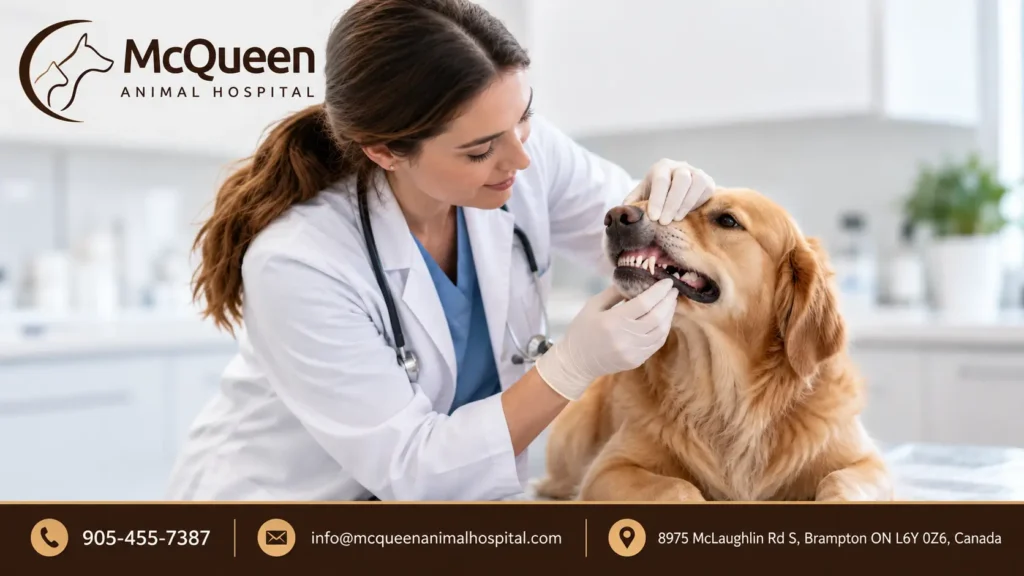
The veterinarian will examine the visible teeth, gums, tongue, and accessible oral tissues for tartar, inflammation, bleeding, loose or fractured teeth, abnormal tissue, swelling, or foreign material.
They will also want to know when the odour began and whether eating behaviour has changed.
A routine awake examination can reveal many problems, but it has limitations. Pain, patient movement, and the position of some oral structures make it impossible to fully assess every tooth and every area beneath the gumline this way.
Why Dental X-Rays May Be Needed
Dental radiographs allow the veterinarian to evaluate structures that cannot be properly seen from the tooth surface.
They can provide information about tooth roots, surrounding bone, periodontal bone loss, and other abnormalities below the gumline. Cornell notes that a thorough assessment of existing dental disease includes oral examination and dental radiographs under anesthesia.
McQueen’s digital dental radiography service is used as part of its dental assessment process when imaging of structures beneath the gumline is needed.
When Blood and Urine Tests May Be Recommended
If the mouth does not explain the bad breath, the veterinarian may need to look elsewhere.
Blood testing and urinalysis can help investigate concerns such as abnormal glucose regulation, kidney dysfunction, liver-related abnormalities, dehydration, and other systemic problems. The exact tests depend on the dog’s history and physical examination rather than the breath symptom alone.
McQueen has an in-house laboratory for laboratory testing when it is clinically indicated.
Further Testing Depends on What the Examination Finds
Not every dog with bad breath needs extensive testing.
A young dog with an obviously damaged tooth and no other abnormalities presents a different clinical problem from an older dog with bad breath, weight loss, vomiting, and increased thirst.
Depending on the findings, a veterinarian may recommend additional imaging, evaluation of abnormal oral tissue, or another diagnostic step. The purpose is not to run every available test. It is to investigate the findings that cannot be adequately explained by the oral examination.
What Should You Check Before the Veterinary Appointment?
You do not need to diagnose the cause before seeing your veterinarian. A good description of what has changed is more useful.
Pay attention to when the smell started, whether it appeared suddenly or gradually, and whether it is present all the time. Watch your dog eat a normal meal and note whether chewing looks different. Check whether drinking, urination, appetite, body weight, energy, vomiting, or stool habits have changed.
Think about what your dog has been chewing recently. Bones, antlers, sticks, damaged toys, and other hard objects can be relevant if a fractured tooth or oral injury is suspected. Cornell advises caution with very hard chew items because they can contribute to tooth wear or fractures.
If your dog comfortably allows you to lift the lip, you can look for visible tartar, inflamed gums, a broken tooth, bleeding, or obvious swelling. Stop if your dog appears uncomfortable. There is no reason to force open a painful mouth simply to get a better look.
Bring a current medication and supplement list, especially if your dog already has another medical condition.
Can Brushing or Dental Products Fix Dog Bad Breath?
Sometimes they help prevent the problem. They cannot be relied upon to treat a problem that is already established.
When Brushing Helps
Regular tooth brushing helps control plaque accumulation and is one of the most useful forms of home dental care.
Home care works best as prevention and maintenance. It is much more effective when started before advanced periodontal disease, painful teeth, or significant gum inflammation have developed.
McQueen’s guide to oral hygiene beyond brushing covers additional ways dental care may be maintained between veterinary examinations.
When Home Dental Care Is Not Enough
Brushing cannot remove disease hidden below the gumline, repair a fractured tooth, treat an infected tooth root, remove a foreign object, diagnose an oral mass, or correct kidney disease or diabetes.
Dental chews, water additives, and breath products can also make a dog’s breath smell better without addressing the reason it smelled bad in the first place.
If your dog’s gums are bleeding, the mouth appears painful, or a tooth is visibly damaged, do not scrub the area more aggressively in an attempt to solve the smell.
When established dental disease requires professional treatment, dog dental cleaning in Brampton allows the oral cavity and teeth to be assessed and treated beyond what home brushing can accomplish.
Persistent Dog Bad Breath Deserves an Explanation
Most persistent bad breath in dogs originates in the mouth, so dental disease is usually the first possibility to investigate. But the right question is not simply, “How can I make my dog’s breath smell better?”
It is, “Why did the breath change?”
If the answer is periodontal disease, a fractured tooth, or another oral problem, treating that condition is more useful than masking the smell. If the dog is also drinking excessively, losing weight, vomiting, or becoming weak, the investigation may need to go beyond the mouth.
For dog owners in Brampton, a dog veterinary examination at McQueen Animal Hospital can help determine whether persistent bad breath is primarily a dental problem or whether another medical issue needs to be investigated.