
Medically reviewed by Dr. Harinder Babbar, DVM
Veterinarian & Medical Director
McQueen Animal Hospital, Brampton, OntarioThis article has been medically reviewed and is based on current evidence-based veterinary literature and clinical guidance.
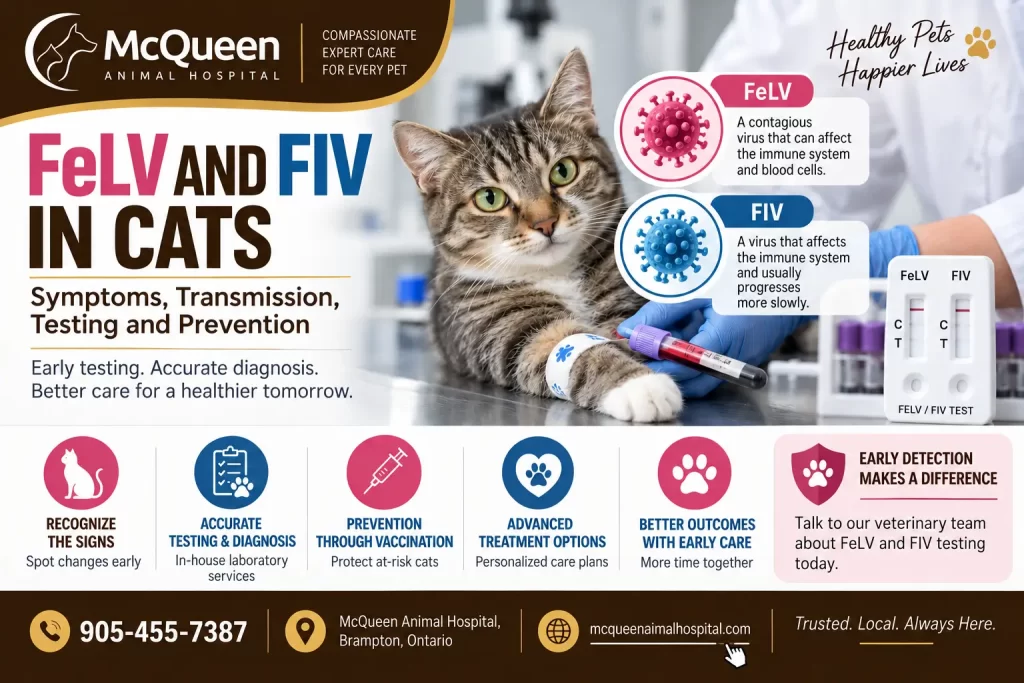
Feline leukemia virus (FeLV) and feline immunodeficiency virus (FIV) are two important viral infections in cats that can weaken the immune system and increase the risk of other health problems. Although FeLV and FIV can cause similar symptoms, they are different viruses and spread differently. FeLV can be transmitted through close contact between cats, while FIV is transmitted primarily through bite wounds. Neither virus is known to infect people, but both can have serious consequences for an infected cat, making early testing, appropriate prevention, and ongoing veterinary care important.
A cat with FeLV or FIV may show no obvious symptoms for months or even years. When illness develops, signs can include weight loss, poor appetite, persistent fever, lethargy, recurrent infections, swollen lymph nodes, dental or mouth inflammation, and other health problems. Because these symptoms can have many different causes, FeLV and FIV testing is important when a cat has been exposed or develops unexplained illness.
FeLV and FIV are related but are not the same disease. They differ in how they spread, how infection is diagnosed and monitored, the risks they pose to other cats, and how they can be prevented. FeLV vaccination is available for cats with appropriate exposure risk, while an FIV vaccine is not currently available in North America. Understanding these differences can help cat owners make informed decisions about testing a new cat, introducing cats into the same household, outdoor access, vaccination, and long-term care.
This guide explains feline leukemia virus and feline immunodeficiency virus in cats, including FeLV and FIV symptoms, how each virus spreads, FeLV vs. FIV differences, testing and diagnosis, what a positive test means, treatment and long-term care, vaccination, and prevention.
What Are FeLV and FIV in Cats?
Feline leukemia virus (FeLV) is a contagious feline retrovirus that can affect the immune system and blood-forming tissues. Progressive FeLV infection may contribute to immune suppression, anemia, recurrent infections, and cancers such as lymphoma and leukemia. Not every exposed cat develops the same type of infection; some cats are able to control the virus, while others develop a persistent infection that can eventually cause serious disease.
For a more focused explanation of the condition, see our guide to What is feline leukemia virus in cats.
Feline immunodeficiency virus (FIV) is also a retrovirus that affects the immune system, but it generally progresses more slowly. An FIV-positive cat may remain apparently healthy for years before immune dysfunction becomes noticeable. When disease develops, affected cats can become more susceptible to infections and may develop problems such as chronic inflammation of the mouth, weight loss, or other illnesses.
Although the names sound similar, FeLV and FIV are not the same disease. Their transmission patterns, testing methods, risk to other cats, and preventive strategies differ. Understanding those differences is particularly important when a cat lives with other cats or has outdoor access.
Neither virus is a human infection. FeLV and FIV are feline-specific viruses and are not known to infect people.
How Does FeLV Spread?
FeLV is most often associated with close, prolonged contact between cats. Infected cats can shed the virus in saliva and other bodily fluids. Transmission can occur through mutual grooming, sharing food or water dishes, bite wounds, and contact between an infected mother and her kittens.
Because close social contact can transmit FeLV, cats living with an infected cat or with cats whose infection status is unknown may have meaningful exposure risk. Kittens are also more susceptible to progressive infection than many adult cats because of their developing immune systems.
How Does FIV Spread?
FIV is transmitted differently. Bite wounds from an infected cat are the primary route of FIV transmission. This is why outdoor cats that roam, defend territory, and fight with unfamiliar cats have a higher risk of infection.
Casual, non-aggressive contact, such as sharing water bowls or mutual grooming, is not considered an efficient route of FIV transmission. As a result, cats that live together peacefully and do not fight generally have a much lower risk of transmitting FIV to one another.
FeLV vs. FIV: What’s the Difference?
FeLV and FIV both affect feline immune function, but the differences matter when assessing exposure, testing, and prevention.
| Feline Leukemia Virus (FeLV) | Feline Immunodeficiency Virus (FIV) | |
|---|---|---|
| Primary transmission | Close contact, saliva, grooming, shared resources, bites, and mother-to-kitten transmission | Primarily bite wounds |
| Higher-risk cats | Cats exposed to infected or unknown-status cats, outdoor cats, and kittens | Outdoor cats, particularly those that fight |
| Disease progression | Can lead to progressive infection and serious disease; some cats control the infection | Usually progresses slowly, and some cats remain healthy for years |
| Possible complications | Immune suppression, anemia, recurrent infections, lymphoma and other cancers | Immune suppression, recurrent infections, oral disease and other complications |
| Testing | Antigen-based screening tests are commonly used; follow-up testing may be needed | Antibody-based screening tests are commonly used; positive results may require confirmation |
| Prevention | Exposure reduction and FeLV vaccination when appropriate | Exposure reduction and preventing fights; an FIV vaccine is not currently available in North America |
The simplest way to remember the distinction is this: FeLV is more closely associated with prolonged close contact, while FIV is much more strongly associated with biting and fighting.
FeLV and FIV Symptoms in Cats
One of the most important things for cat owners to understand is that FeLV and FIV symptoms are not always obvious. An infected cat may look healthy for a long time, so appearance alone cannot reliably determine whether a cat is infected.
Possible signs associated with FeLV or FIV include:
- Loss of appetite
- Weight loss
- Persistent or recurring fever
- Lethargy or weakness
- Enlarged lymph nodes
- Recurrent infections
- Chronic diarrhea
- Skin or eye problems
- Poor coat condition
- Pale gums associated with anemia
- Dental disease or inflammation of the mouth
- Reproductive problems
- Certain cancers
These symptoms are not specific to feline leukemia virus or feline immunodeficiency virus. A cat with weight loss, fever, diarrhea, oral inflammation, or recurrent infections could have a number of other medical conditions. That is why veterinary examination and appropriate testing are more useful than trying to diagnose FeLV or FIV from symptoms alone.
Cats can also be remarkably good at hiding illness. Changes in appetite, weight, activity level, grooming, or behaviour can sometimes be the first indication that something is wrong. Early veterinary evaluation is especially important when a cat has a known exposure risk. Our guide to Subtle signs of illness in cats explains why these changes should not be overlooked.
When Should a Cat Be Tested for FeLV or FIV?
Testing is appropriate when there is a reasonable possibility of exposure, when a cat becomes ill without an obvious explanation, or when a new cat is entering a household.
Your veterinarian may recommend FeLV and FIV testing when:
- You adopt a new cat or kitten.
- Your cat has never been tested.
- Your cat has been exposed to an infected cat.
- Your cat has been exposed to a cat of unknown infection status.
- Your cat goes outdoors.
- Your cat has been involved in a fight or sustained a bite wound.
- Your cat develops unexplained illness.
- Another cat is being introduced into the household.
- Your veterinarian is assessing whether FeLV vaccination is appropriate.
The American Association of Feline Practitioners recommends testing cats after acquisition, following possible exposure, and when clinical illness occurs. Testing can help identify infection earlier and inform decisions about prevention and household management.
How Are FeLV and FIV Diagnosed?
FeLV and FIV are generally diagnosed with blood tests, but a result should be interpreted in context rather than treated as an isolated yes-or-no answer.
FeLV Testing
FeLV screening commonly uses an antigen test such as an ELISA to detect viral components in the blood. Because FeLV infection can develop in different ways, a single test may not always establish the cat’s long-term infection status. Follow-up testing can be important, particularly after a positive screening result or recent exposure.
A positive FeLV screening result does not automatically tell you whether the infection is progressive or regressive. Additional testing can help your veterinarian clarify the diagnosis and determine the appropriate management plan.
FIV Testing
FIV screening tests generally detect antibodies produced by a cat in response to infection. A positive result may indicate infection, but false-positive results can occur, so confirmation may be appropriate, particularly in a healthy cat with a low likelihood of exposure.
Timing also matters. A cat infected recently may test negative before enough detectable antibodies have developed. If exposure has occurred recently, your veterinarian may recommend repeat testing after an appropriate interval.
When laboratory testing is needed, In-house veterinary laboratory testing can support timely diagnostic evaluation.
Your veterinarian can also explain Why blood tests matter for cats and how blood work fits into your cat’s overall health assessment.
What Does a Positive FeLV or FIV Test Mean?
A positive screening test should not automatically be interpreted as a prediction of how sick a cat will become.
The next step depends on the virus involved, the type of test used, the cat’s age and health, previous test results, vaccination history where relevant, and the timing and likelihood of exposure. Your veterinarian may recommend confirmatory or repeat testing before making important long-term decisions.
This is particularly important when an otherwise healthy cat unexpectedly receives a positive result.
Can Cats With FIV or FeLV Live With Other Cats?
Whether infected cats can safely live with other cats depends on the virus and the household.
Living With an FIV-Positive Cat
Because FIV is primarily transmitted through bite wounds, the risk is much lower in households where cats coexist peacefully and do not fight. A stable social environment is therefore very different from a household in which cats regularly engage in aggressive interactions.
Cats entering a household with an FIV-positive cat should be evaluated and tested. Your veterinarian can help you assess the individual cats, their behaviour, and the best way to reduce the chance of fighting.
An FIV-positive diagnosis does not automatically mean that a cat must be separated from its family or that its quality of life will be poor. Many infected cats can remain healthy for years with appropriate veterinary care.
Living With an FeLV-Positive Cat
FeLV requires greater caution because it can spread through close social contact.
Cats that have been exposed should be tested, and FeLV-positive and FeLV-negative cats are generally managed separately to reduce transmission risk. Vaccination may provide additional protection for cats that remain at risk, but it does not replace testing or exposure control.
Your veterinarian can help determine the safest arrangement based on the cats involved, their vaccination status, household environment, and ability to prevent exposure.
Is There a Vaccine for FeLV or FIV?
FeLV Vaccination
Yes. An FeLV vaccine is available and can be an important part of prevention for cats with exposure risk.
FeLV vaccination is commonly considered for kittens and for cats whose lifestyles put them at risk, including cats that go outdoors or may have contact with cats whose infection status is unknown. Vaccination does not treat an existing FeLV infection, and it does not provide complete protection in every vaccinated cat, so reducing exposure remains important.
Your veterinarian can determine whether an adult indoor cat should continue receiving FeLV vaccination based on its individual lifestyle and exposure risk. For more information about feline preventive care, see our page on Cat vaccinations and prevention.
FIV Vaccination
An FIV vaccine is not currently commercially available in North America. Because FIV is primarily spread through bites, preventing fights and limiting contact with potentially infected cats are central to prevention.
Because FIV transmission is strongly associated with fighting, keeping cats indoors and preventing contact with unfamiliar cats can significantly reduce exposure risk.
If you live outside North America, vaccine availability may differ, so vaccination decisions should be discussed with a local veterinarian.
What Is the Treatment for FeLV and FIV?
There is currently no definitive cure that reliably eliminates FeLV or FIV from an infected cat. Treatment focuses on supporting the cat’s health, managing individual medical problems, limiting exposure to additional infections, and identifying complications as early as possible.
A positive diagnosis does not necessarily mean a cat is sick at the time of diagnosis. Some cats remain apparently healthy for an extended period. Prognosis varies according to the virus, the nature and stage of infection, the cat’s age and overall health, and whether other diseases are present.
For an infected cat, routine veterinary care is particularly important. Your veterinarian may recommend regular examinations and prompt investigation of changes such as weight loss, appetite changes, recurring infections, fever, diarrhea, oral inflammation, or unusual tiredness.
Keeping infected cats indoors can also reduce exposure to additional infections, prevent fighting and injury, and lower the chance of transmitting the virus to other cats.
What Should I Do if My Cat Has Been Bitten?
A cat bite should be taken seriously even when the wound appears small.
Cat teeth can push bacteria deep beneath the skin, and puncture wounds can develop into painful abscesses. A fight can also expose a cat to FeLV or FIV.
Contact your veterinarian after a significant bite or fight. Your veterinarian can examine the wound, determine whether treatment is needed, and advise you about appropriate FeLV and FIV testing.
A test performed immediately after exposure may not always rule out infection because some tests require time before an infection can be detected. Follow-up testing may therefore be recommended based on the circumstances.
How Can I Prevent FeLV and FIV?
The best prevention strategy is to reduce exposure and understand the infection status of cats entering your household.
Keep cats indoors or provide controlled outdoor access, prevent fighting with unfamiliar cats, and have newly adopted cats examined and tested before introducing them to resident cats. If an indoor cat’s lifestyle changes and it begins spending time outdoors, its infectious disease and vaccination risks should be reassessed.
For FeLV, vaccination can provide an additional layer of protection for cats with appropriate exposure risk. For FIV, preventing bite wounds and fighting is especially important because there is currently no FIV vaccine available in North America.
Living With a Cat That Has FeLV or FIV
A diagnosis of feline leukemia virus or feline immunodeficiency virus can be upsetting, but it does not automatically mean that a cat is immediately ill or unable to have a good quality of life.
The first step is to understand exactly what the test result means and whether additional testing is appropriate. From there, your veterinarian can create a care plan based on your cat’s infection status, lifestyle, age, and overall health.
Regular veterinary examinations, appropriate preventive care, good nutrition, parasite control, and prompt attention to new symptoms all become especially important. Cats with FeLV or FIV should not be judged by their diagnosis alone; their individual health status and ongoing medical needs matter.
At McQueen Animal Hospital in Brampton, our veterinary team can help with FeLV and FIV testing, interpretation of results, preventive care, vaccination decisions, and ongoing monitoring for cats that have been exposed or diagnosed with either virus. A Cat health consultation and examination can help determine the appropriate next steps for your cat.
Frequently Asked Questions About FeLV and FIV in Cats
Q1. Can a cat have FeLV or FIV without showing symptoms?
Yes. Both FeLV and FIV can occur in cats that appear completely healthy. Some infected cats may have no obvious signs for months or years, which is why exposure history and appropriate testing are important even when a cat seems well.
Q2. How long after exposure should a cat be tested for FeLV or FIV?
The appropriate testing interval depends on which virus is involved, the test being used, and when the exposure occurred. Testing immediately after a recent exposure may not rule out infection because the virus or the cat’s immune response may not yet be detectable. Your veterinarian may recommend repeat testing after an appropriate interval.
Q3. Can an FIV-positive cat live safely with an FIV-negative cat?
In some households, yes. Because FIV is primarily transmitted through bite wounds, cats that live together peacefully and do not fight have a much lower transmission risk than cats involved in aggressive interactions. Your veterinarian can help assess the cats’ behaviour and household circumstances before making a decision.
Q4. Should an FeLV-positive cat be separated from other cats?
FeLV requires greater caution because it can spread through close contact between cats. FeLV-positive and FeLV-negative cats are generally managed separately to reduce transmission risk. The appropriate arrangement should be discussed with a veterinarian after considering the cats’ test results, vaccination status, and living environment.
Q5. Does a positive FeLV or FIV test mean my cat will become seriously ill?
Not necessarily. A positive result indicates that further veterinary assessment may be needed, but it does not by itself predict how quickly a cat will become ill or how long it will remain healthy. The outlook depends on the virus, the type or stage of infection, the cat’s overall health, and whether other medical problems are present. Your veterinarian can help interpret the result and establish an appropriate monitoring plan.