
Medically reviewed by Dr. Harinder Babbar, DVM
Veterinarian & Medical Director
McQueen Animal Hospital, Brampton, OntarioThis article has been medically reviewed and is based on current evidence-based veterinary literature and clinical guidance.
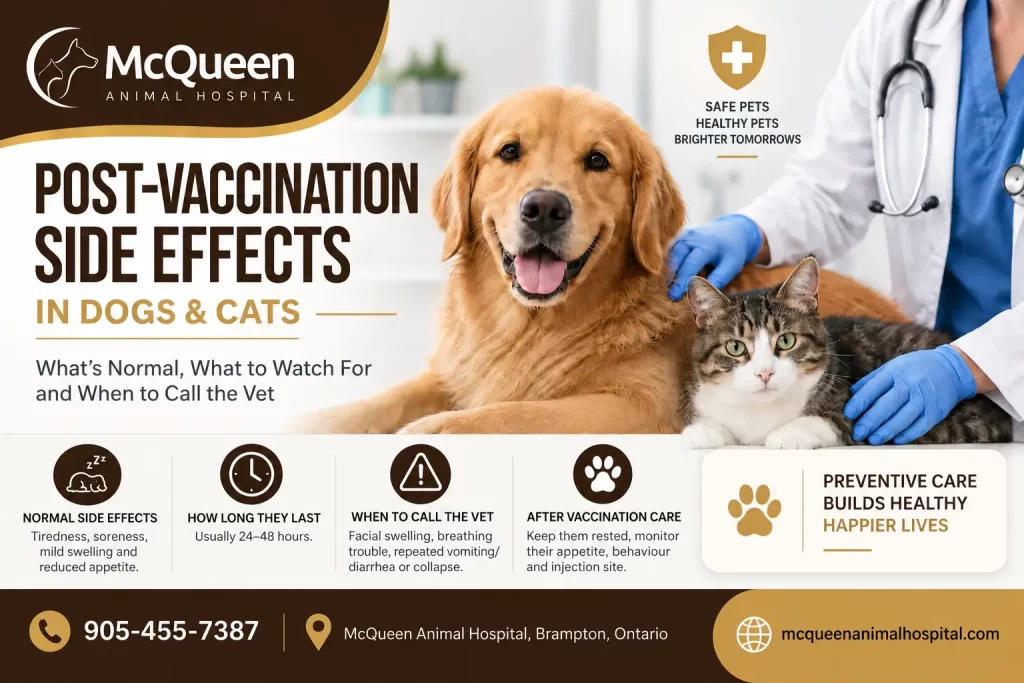
Vaccination is an important part of protecting dogs and cats from serious infectious diseases, but mild post-vaccination side effects can occur. The most common reactions include temporary tiredness, soreness or mild swelling at the injection site, a slightly reduced appetite, and a mild fever. In most pets, these dog and cat vaccine side effects are mild and improve within 24 to 48 hours. Our comprehensive animal vaccination services help protect pets from preventable infectious diseases.
However, not every reaction should be considered normal. Facial swelling, hives, difficulty breathing, repeated vomiting or diarrhea, severe weakness, or collapse after vaccination can indicate a serious allergic reaction and require immediate veterinary attention. If your pet develops symptoms that are severe, worsening, or not improving as expected, contact your veterinarian rather than waiting for them to resolve.
Understanding what is normal after a vaccination—and knowing when to call the vet after vaccination—can help you monitor your pet confidently and recognize when professional care is needed.
Common side effects after dog and cat vaccinations
Mild vaccine reactions are relatively common and usually resolve on their own. They can occur because vaccination stimulates the immune system, and a temporary inflammatory response is part of developing protection.
After a vaccination, your pet may be quieter than usual or sleep more. They may have a slightly reduced appetite, mild soreness at the injection site, or a small amount of swelling. Some pets develop a mild fever or seem reluctant to exercise because the area where the vaccine was administered is uncomfortable.
These signs are generally short-lived. A pet who is mildly tired but remains alert, comfortable, and responsive can usually be monitored at home. Most mild post-vaccination effects improve within about 24 to 48 hours.
Normal or mild vaccine reactions can include:
- Mild tiredness or sleeping more than usual
- Slightly decreased appetite
- Mild soreness or tenderness where the vaccine was given
- A small amount of redness or swelling at the injection site
- Mild fever
- Temporary reluctance to exercise
- Mild sneezing or nasal discharge after certain intranasal vaccines
The presence of one of these signs does not automatically mean your pet is having a dangerous reaction. What matters is the severity, duration, and progression of the symptoms, as well as how your pet is behaving overall.
Dog vaccine side effects: what to expect
Dogs may experience mild soreness, fatigue, reduced appetite, or a low-grade fever after vaccination. Some dogs simply want to rest for the remainder of the day, particularly after an appointment that involved several vaccines or was stressful for them.
A dog who is tired but still responsive and comfortable is generally less concerning than one who becomes extremely weak, develops breathing difficulties, or shows signs of an allergic reaction. If your dog is gradually returning to normal over the next day or two, that is reassuring.
Your veterinarian may recommend a vaccination schedule based on your dog’s age, lifestyle, health, previous vaccination history, and risk of exposure to particular diseases. If your dog has previously experienced a vaccine reaction, tell your veterinary team before future vaccinations so they can take that history into account. For puppies, following a puppy vaccination schedule and guidance can help ensure age-appropriate protection.
Cat vaccine side effects: what to expect
Cats can also experience temporary tiredness, reduced appetite, mild fever, or tenderness after vaccination. Some cats may hide or be less social for a short period because they are tired or uncomfortable.
A small lump can occasionally develop at the injection site. A localized inflammatory response does not necessarily indicate a serious problem, but injection-site masses in cats should be monitored carefully.
The AAHA/AAFP feline vaccination guidelines recommend that a mass be investigated if it remains for three months, is larger than 2 cm, or continues to increase in size one month after vaccination. This is commonly referred to as the 3-2-1 rule.
If you notice a lump after your cat’s vaccination, avoid repeatedly pressing or manipulating it. Instead, monitor its size and appearance and contact your veterinarian if it persists, grows, becomes painful, or concerns you. For additional information about preventive immunization, see this cat immunization guidance for pet owners.
Normal vaccine reaction vs. a reaction that needs veterinary attention
Knowing what to watch for can make the hours after vaccination much less stressful. Not every change requires an emergency visit, but some symptoms should prompt a call to your veterinarian.
| Usually mild | Contact your veterinarian | Emergency signs |
|---|---|---|
| Mild tiredness | Symptoms that are not improving | Difficulty breathing |
| Slightly reduced appetite | Significant or persistent loss of appetite | Facial or muzzle swelling |
| Mild soreness | Increasing pain or swelling | Collapse or fainting |
| Small injection-site swelling | A lump that persists, grows, or concerns you | Severe weakness |
| Mild fever | Symptoms lasting longer than expected | Repeated or severe vomiting |
| Temporary reluctance to exercise | Your pet is behaving unusually or seems increasingly unwell | Severe allergic reaction |
This is a general guide rather than a substitute for veterinary assessment. If you are worried about your pet after vaccination, it is appropriate to contact your veterinary team even if the symptoms do not fit neatly into one category. A professional pet consultation and examination can help determine whether your pet needs further evaluation.
How long do vaccine side effects last in dogs and cats?
Most mild vaccine side effects are temporary and improve within roughly 24 to 48 hours. Your pet may be sleepy on the day of vaccination and gradually return to normal activity afterward.
The trend is important. If your dog or cat is becoming more comfortable and returning to normal eating and activity, that is generally reassuring. If symptoms are becoming more severe, new symptoms are developing, or your pet does not seem to be recovering as expected, contact your veterinarian.
There is no reason to wait for a particular number of hours if your pet appears seriously ill. Difficulty breathing, collapse, facial swelling, or other signs of a severe allergic reaction require immediate veterinary attention.
When should you call the vet after vaccination?
Call your veterinarian if your pet’s symptoms are significant, persistent, worsening, or simply seem different from what you were told to expect after vaccination.
For example, a mildly decreased appetite may be temporary. A pet who refuses food for an extended period, becomes progressively lethargic, develops significant pain, or shows other concerning symptoms should be assessed more carefully.
You should also contact your veterinarian if you notice a large or increasingly painful injection-site swelling, particularly if it does not appear to be settling down.
And if you are unsure, you do not need to diagnose the reaction yourself before calling. Your veterinary team can ask about the timing and nature of the symptoms and help determine whether your pet should be monitored at home or examined.
What does an allergic reaction to a vaccine look like?
A serious allergic reaction is different from the mild soreness or tiredness that can occur after vaccination. Hypersensitivity reactions can develop relatively quickly and may become serious if they affect breathing or circulation.
Possible warning signs include:
- Swelling around the face, eyes, lips, or muzzle
- Hives or raised, itchy bumps on the skin
- Difficulty breathing
- Repeated vomiting or diarrhea
- Sudden severe weakness
- Collapse or fainting
These signs can be associated with a severe allergic reaction, including anaphylaxis. If your pet develops difficulty breathing, facial swelling, collapse, or other severe symptoms after vaccination, seek emergency veterinary care immediately.
Do not wait to see whether a severe reaction resolves on its own.
What should you do after your pet gets vaccinated?
After your pet’s appointment, give them a quiet opportunity to rest. Keep fresh water available and offer their usual food. There is generally no need to encourage strenuous exercise if your pet is sore or tired.
Keep an eye on your pet’s:
- Appetite and water intake
- Energy and responsiveness
- Breathing
- Injection site
- Overall comfort
- Any new or worsening symptoms
If your pet has a mild reaction, you can monitor them while they rest. Do not give human pain relievers or other medications unless your veterinarian specifically instructs you to do so. Some medications that are safe for people can be dangerous or even toxic to dogs and cats.
It is also useful to keep a record of which vaccines your pet received. If a reaction occurs, your veterinarian can use that information when deciding how to approach future vaccinations.
What if your pet has reacted to a vaccine before?
A previous vaccine reaction is important information for your veterinarian, but it does not necessarily mean your pet can never be vaccinated again.
The appropriate approach depends on what happened, how severe the reaction was, which vaccine was involved, and your pet’s individual risk of the diseases those vaccines prevent. Your veterinarian may consider changes to the vaccination plan or additional precautions based on your pet’s history.
For this reason, tell your veterinary team about any previous reaction before your pet receives future vaccines. Accurate information about what happened and how quickly the symptoms developed can be particularly helpful.
When a vaccine reaction is not actually caused by the vaccine
It is also possible for a health problem to appear shortly after vaccination without being caused by the vaccine itself. Pets can develop unrelated illnesses at any time, and the timing can sometimes make the two events appear connected.
That is one reason persistent or unusual symptoms should not automatically be assumed to be a vaccine reaction. If your pet is not recovering as expected, a veterinarian can determine whether the symptoms are consistent with a post-vaccination response or whether another medical problem needs attention.
Vaccination remains an important part of preventive care
It is understandable to be concerned when your pet does not seem quite like themselves after a vaccination. Fortunately, serious vaccine reactions are uncommon, while vaccination provides important protection against potentially serious infectious diseases. Current veterinary vaccination guidelines continue to recognize vaccination as a fundamental part of preventive healthcare for dogs and cats.
The goal is not to ignore vaccine reactions or to worry about every minor change. It is to understand what is expected, monitor your pet appropriately, and recognize the signs that require veterinary attention.
If your dog or cat is experiencing a reaction after vaccination and you are unsure whether it is normal, contact McQueen Animal Hospital in Brampton for guidance. Our veterinary team can help you determine whether your pet’s symptoms can be monitored at home or whether an examination is needed.
For vaccine-specific information for dogs, you can also review leptospirosis vaccine information for dogs when discussing your pet’s vaccination needs with your veterinarian.