
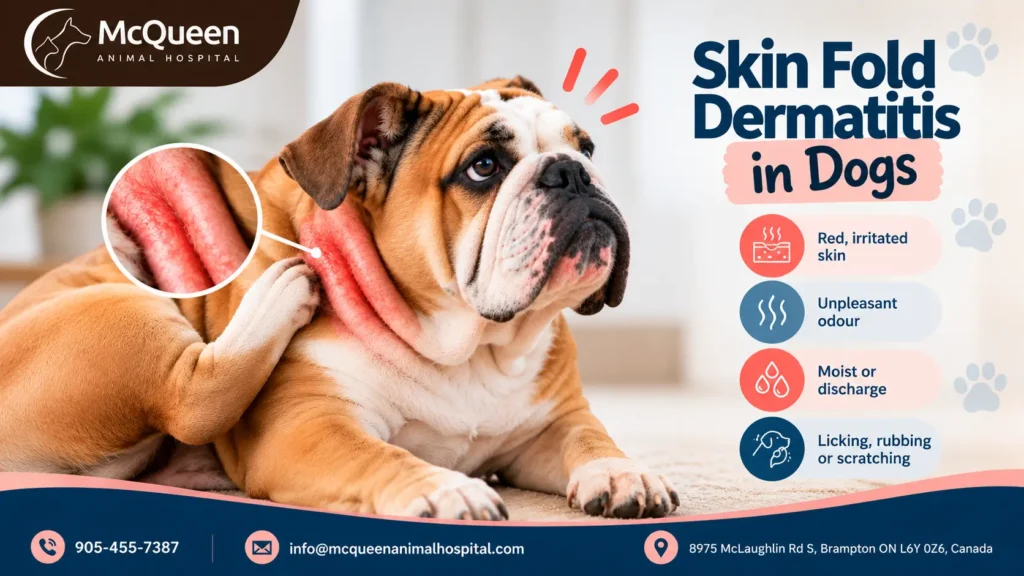
Skin fold dermatitis in dogs, also called intertrigo, is inflammation that develops where skin rubs against skin and moisture, heat, and debris become trapped. It can cause redness, irritation, odour, dampness, discharge, and discomfort. Bacteria or yeast may also multiply in the affected area, sometimes leading to a secondary infection.
The condition is more common in dogs with prominent facial, lip, tail, vulvar, or other skin folds, but any dog can develop it. Because similar-looking skin problems can have different causes, persistent or recurring irritation should be assessed by a veterinarian rather than diagnosed by appearance alone.
Research snapshot: A large UK study using primary-care veterinary records from 905,553 dogs found that skin fold dermatitis was recorded in approximately 0.37% of dogs over one year. The same study found a higher recorded prevalence in brachycephalic dogs (1.02%) than in mesocephalic dogs (0.26%). These figures come from dogs receiving veterinary care in the UK in 2016 and should not be treated as a current prevalence estimate for dogs in Canada. Scientific Reports study on skin fold dermatitis in dogs.
What Is Skin Fold Dermatitis in Dogs?
Skin fold dermatitis develops when two areas of skin stay in close contact for prolonged periods.
Several factors can contribute at the same time:
- Friction between skin surfaces can damage and irritate the skin.
- Moisture from saliva, tears, urine, bathing, or normal skin secretions can become trapped.
- Reduced airflow can keep the area warm and damp.
- Bacteria or yeast that normally live on the skin may multiply excessively.
- Ongoing inflammation can make the area more painful and susceptible to further irritation.
In some dogs, the problem remains limited to inflammation and microbial overgrowth. In others, bacterial infection or deeper skin disease may develop. The distinction matters because treatment depends on what is actually affecting the skin.
Where Does Skin Fold Dermatitis Usually Occur?
Common locations include:
- Facial and nose folds
- Lip folds
- Tail folds
- Vulvar folds
- Groin folds
- Other areas where skin remains closely pressed together
A dog’s anatomy can make certain areas more prone to moisture and friction, but anatomy is not the only factor. Allergies, chronic skin inflammation, moisture, and other underlying conditions can also contribute to recurrent problems.
What Does Skin Fold Dermatitis Look Like?
The appearance can range from mild irritation to significantly inflamed or damaged skin.
You may notice:
- Red or pink skin
- Damp or greasy skin
- A strong or unusual odour
- Hair loss around the fold
- Darkened or thickened skin
- Crusting
- Discharge
- Swelling
- Tenderness or pain
- Frequent licking, rubbing, or scratching
Not every dog will have all of these signs.
Odour can be an important clue
A noticeable smell coming from a skin fold can occur when moisture and debris accumulate or when bacteria or yeast become excessive. Odour by itself cannot tell you exactly what is causing the problem, but a new or worsening smell—especially with redness, discharge, swelling, or discomfort—is a reason to pay closer attention.
What Causes Skin Fold Dermatitis?
Skin fold dermatitis usually results from a combination of factors rather than one isolated cause.
Deep or closely positioned skin folds
When skin surfaces remain pressed together, there is less ventilation and more opportunity for heat and moisture to accumulate. Repeated friction can also weaken the skin barrier.
Moisture and trapped secretions
Saliva, tears, urine, skin oils, and other secretions can collect inside folds. Persistent moisture can increase irritation and create an environment where microorganisms multiply more easily.
Bacteria and yeast
Bacteria and yeast are normally present on canine skin. Problems may occur when the environment of a skin fold changes and these organisms become excessively abundant or contribute to inflammation.
This is an important distinction: finding bacteria or yeast does not automatically mean that a dog has a deep infection. A veterinarian may use examination findings and skin testing to determine whether microbial overgrowth is clinically significant and whether infection is present.
Allergic skin disease
Dogs with allergies can develop chronic skin inflammation and itching that makes fold problems more likely to recur. Other clues may include itchy paws, recurrent ear problems, or irritation in other areas of the body.
An irritated skin fold should not automatically be assumed to be caused by an allergy. Determining whether an allergy is involved requires considering the dog’s broader history and skin findings.
Body condition and skin folds
Excess body tissue can contribute to skin-to-skin contact in some dogs, but body weight is only one possible factor. The structure of the folds, their location, the dog’s individual skin health, and other medical conditions can all influence recurrence.
Is Skin Fold Dermatitis an Infection?
Not always.
Skin fold dermatitis refers to inflammation within the fold. Bacterial or yeast overgrowth can occur at the same time, and some dogs may develop a true bacterial skin infection.
The difference is clinically important. A veterinarian may recommend skin cytology or other testing to determine whether bacteria, yeast, inflammatory cells, or another problem is contributing to the signs.
This is also why antibiotics are not automatically appropriate for every red or smelly skin fold. Treatment should be based on the underlying findings and the severity of the condition.
Current 2025 guidelines from the International Society for Companion Animal Infectious Diseases recommend confirming bacterial involvement with cytology before antimicrobial treatment for suspected canine pyoderma and emphasize topical therapy for surface and superficial disease, with systemic antimicrobials reserved for appropriate cases such as deeper infection. 2025 ISCAID canine pyoderma antimicrobial guidelines.
Can Skin Fold Dermatitis Become Serious?
Many cases can be managed successfully, but ongoing inflammation should not be ignored.
As the condition progresses, the skin may become increasingly sore and damaged. More concerning changes include:
- Significant swelling
- Marked pain
- Open sores or ulcers
- Blood or pus
- Rapid worsening
- Skin changes extending beyond the original fold
- A dog that appears unwell in addition to having the skin problem
Deep skin infections are more serious than simple fold irritation and may require a different treatment approach.
The location of the affected fold also matters. For example, problems near the eyes require particular caution because inappropriate products can irritate sensitive tissue.
When Should You Contact a Veterinarian?
Arrange a veterinary appointment when a skin fold remains irritated, smells unusual, or repeatedly develops problems, especially if you notice:
- Persistent redness or inflammation
- Ongoing moisture or discharge
- Repeated licking, rubbing, or scratching
- Hair loss
- Crusting
- Swelling
- Tenderness or pain
- Recurrent flare-ups
- Skin changes that are spreading
A recurring problem is particularly worth investigating. Treating the visible irritation without addressing a contributing allergy, moisture issue, infection, or anatomical factor may allow the problem to return.
A Comprehensive veterinary skin examination for pets can help your veterinarian assess the affected area and determine whether further evaluation is needed.
When is urgent veterinary care appropriate?
Prompt veterinary assessment is appropriate when the affected area becomes markedly painful, rapidly swollen, ulcerated, or produces significant blood or pus.
Emergency veterinary attention is warranted when serious signs affecting your dog’s overall health occur alongside the skin problem, such as collapse, severe weakness, difficulty breathing, or another rapidly developing medical issue.
The urgency depends on your dog’s complete condition, not simply on the presence of skin fold dermatitis. When immediate attention is needed, Compassionate emergency veterinary care services may be appropriate.
What Will a Veterinarian Check?
A veterinary visit usually starts with a detailed history and physical examination.
The veterinarian may ask:
- When did the problem begin?
- Has it happened before?
- Which skin folds are affected?
- Is the condition getting better or worse?
- Is your dog licking or scratching the area?
- Is there an unusual odour or discharge?
- Has your dog had previous skin infections?
- What products or treatments have been used?
- Does your dog have itchy paws, ears, or other skin problems?
- Is your dog receiving regular parasite prevention?
- Have there been recent changes in grooming, diet, environment, or routine?
The veterinarian may also examine other areas of the skin because a fold problem can sometimes occur alongside a broader skin condition.
What tests might be needed?
Testing depends on what the veterinarian finds during the examination.
Skin cytology may be used to look for bacteria, yeast, and inflammatory cells.
Skin scrapings or other diagnostic tests may be considered when parasites or other skin diseases need to be investigated.
Bacterial culture and susceptibility testing may be appropriate for certain recurrent or deeper bacterial infections, particularly when treatment needs to be selected based on the organisms involved.
For cases that require additional investigation, Pet pathology and diagnostic testing services may form part of the diagnostic process.
Where appropriate, In-house veterinary laboratory testing services can also support veterinary assessment and diagnostic decision-making.
Testing is useful because the visible appearance of a skin fold does not always reveal what is happening beneath the surface.
How Is Skin Fold Dermatitis Treated?
Treatment depends on the dog’s examination findings, the affected location, the severity of inflammation, whether infection is present, and whether an underlying problem is contributing.
Cleaning and reducing moisture
Keeping affected folds appropriately clean and dry is an important part of management. Your veterinarian may recommend a specific cleaning routine based on your dog’s skin condition and the location of the fold.
Avoid aggressive scrubbing, particularly when the skin is already painful or damaged.
Topical treatment
A veterinarian may recommend a pet-safe topical treatment to address inflammation, bacteria, yeast, or a combination of problems.
The right product depends on the location and the findings. This is especially important for folds close to the eyes, mouth, or genital area, where some products may not be appropriate.
Treating an underlying condition
When allergies, parasites, chronic moisture, or another medical problem are contributing to recurrent dermatitis, managing that underlying issue may be an important part of long-term control.
Systemic medication
Some dogs may need medication that works throughout the body, particularly when infection is deeper or more extensive.
However, systemic antibiotics are not automatically needed for every case of skin fold dermatitis. A veterinarian should determine whether they are appropriate based on the examination and, when indicated, diagnostic testing.
Surgery in selected cases
Some dogs experience severe or repeatedly recurring problems because of the structure of a particular skin fold.
When medical management does not adequately control the condition, a veterinarian may discuss whether a surgical procedure to address problematic skin folds could be appropriate. This is an individual decision based on the dog’s anatomy, severity, recurrence, and overall health.
What Can You Do at Home?
For dogs that are prone to skin fold problems, regular observation can help you notice changes early.
You can:
- Check the folds regularly for redness, moisture, odour, or discharge.
- Follow the cleaning routine recommended by your veterinarian.
- Dry the area appropriately after cleaning or bathing.
- Watch for increased licking, scratching, or rubbing.
- Keep track of how often flare-ups occur.
Use only products that are appropriate for dogs and suitable for the affected body area. Do not use household disinfectants, essential oils, or human skin medications unless your veterinarian has specifically advised you to do so.
Do not aggressively clean or probe a painful, ulcerated, bleeding, or severely inflamed fold. In those situations, veterinary assessment is more appropriate than repeated home treatment.
How Can Skin Fold Dermatitis Be Prevented?
Prevention depends on why your dog is prone to the condition, but may include:
Regular inspection: Check skin folds during grooming and normal handling.
Appropriate cleaning: Some dogs need a regular cleaning routine because of their anatomy or history of recurrent dermatitis.
Keeping folds dry: Moisture can contribute to irritation and microbial overgrowth, so appropriate drying is important.
Managing underlying skin disease: If allergies or another condition is causing chronic inflammation, controlling that problem may reduce recurrence.
Maintaining a healthy body condition: For dogs where excess body tissue contributes to skin-to-skin contact, appropriate weight management may form part of the overall plan.
Addressing anatomical problems: Dogs with severe recurrent dermatitis may need an evaluation to determine whether the structure of the fold itself is contributing to the problem.
What Should You Bring to Your Veterinary Appointment?
A few details can help your veterinarian understand how the problem has developed.
Consider bringing or noting:
- When you first noticed the problem
- Which folds are affected
- Whether it has happened before
- Changes in odour, discharge, redness, or swelling
- How often your dog licks or scratches the area
- What cleaning products or treatments you have used
- Any recent medications
- Your dog’s parasite-prevention routine
- Any other skin or ear problems
Photos taken during a flare can also be useful if the skin looks different by the time of the appointment.
FAQs About Skin Fold Dermatitis in Dogs
Can I use baby wipes or human creams on my dog’s skin folds?
It is better not to assume that a product made for people is safe or appropriate for a dog’s skin fold. Products can contain ingredients that may irritate inflamed skin, and the risk is greater in sensitive locations such as facial folds. Ask your veterinarian which products are appropriate for your dog’s specific skin and the affected area before applying an over-the-counter cream or cleanser.
How long does it take for skin fold dermatitis to improve?
There is no single recovery time for every dog. Improvement depends on whether the problem is primarily irritation, microbial overgrowth, superficial infection, deeper infection, or part of an underlying skin disorder. If the area is worsening, becoming more painful, or not improving as expected after veterinary-directed treatment, contact your veterinarian rather than changing the treatment yourself.
Is skin fold dermatitis contagious to other dogs?
Skin fold dermatitis itself is generally caused by local factors such as friction, moisture, and skin-fold anatomy rather than by a contagious disease. However, other skin conditions can sometimes look similar, and some of those conditions can be contagious. A new or unusual skin lesion should therefore not automatically be assumed to be ordinary skin fold dermatitis.
Skin Fold Dermatitis in Dogs: What Matters Most
Skin fold dermatitis develops when friction, moisture, heat, and poor ventilation create ongoing irritation within a skin fold. Bacteria or yeast may contribute, but not every irritated fold represents the same type of infection or requires the same treatment.
For owners, the most important things to watch are changes in redness, moisture, odour, discharge, swelling, pain, and recurrence.
A mild irritation that settles with an established veterinary-directed care routine is different from a fold that is becoming increasingly painful, swollen, ulcerated, or infected. Recurrent problems also deserve attention because an underlying allergy, skin disorder, moisture problem, or anatomical factor may be contributing.
When your dog’s skin folds remain red, moist, smelly, painful, or repeatedly inflamed, a veterinary examination can help determine what is causing the problem and what type of treatment or prevention plan is appropriate.
For dogs in Brampton, Professional veterinary care for dogs can help address persistent or recurring skin concerns.
Medically reviewed by Dr. Harinder Babbar, DVM
Veterinarian & Medical Director, McQueen Animal Hospital, Brampton, OntarioThis article has been medically reviewed and is based on current evidence-based veterinary literature and clinical guidance.