
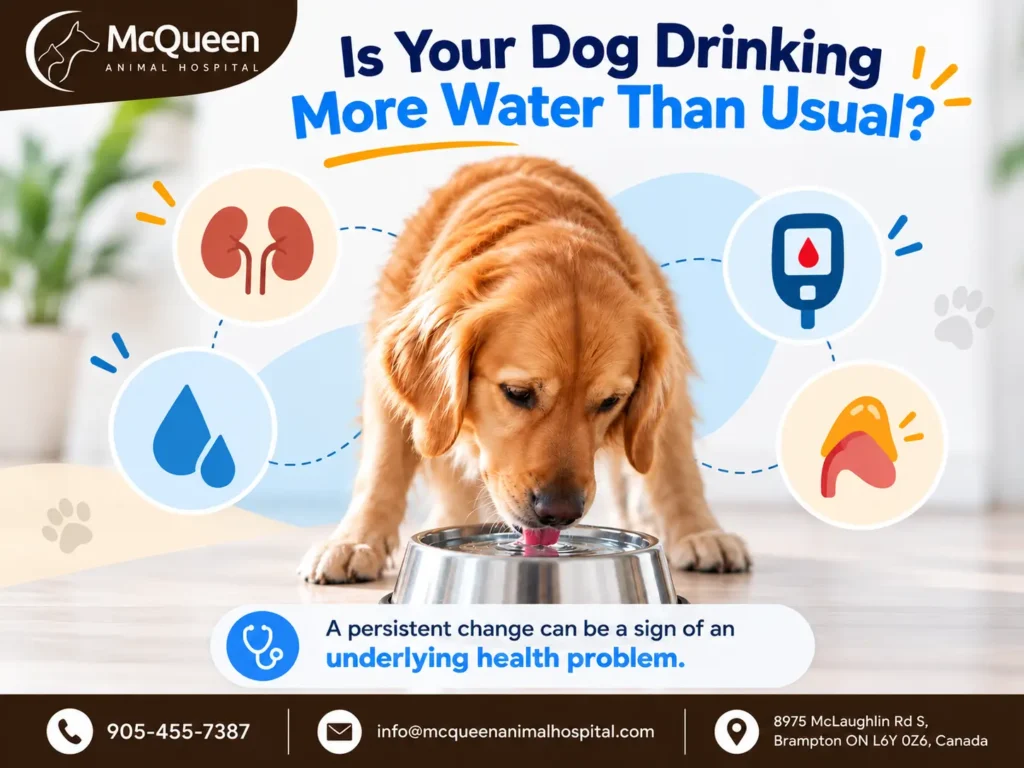
If your dog is suddenly drinking much more water than usual, it may be caused by something as simple as hot weather or increased activity, but persistent excessive thirst can also signal an underlying health problem. Increased thirst, especially when accompanied by increased urination, weight loss, vomiting, appetite changes, or lethargy, should be discussed with a veterinarian.
Veterinarians call excessive drinking polydipsia. It is a symptom rather than a disease, and there are many possible causes, including medication effects, diabetes, kidney disease, hormonal disorders, liver problems, and certain urinary or reproductive conditions.
The important thing is to look at the overall change in your dog’s health, rather than assuming that excessive thirst points to one specific condition.
How much water is too much for a dog?
There is no single amount of water that is abnormal for every dog. Water needs vary with body size, diet, activity level, weather, and overall health.
Rather than focusing only on a specific amount, pay attention to a persistent change from your dog’s normal drinking habits.
You may notice that your dog:
- Empties the water bowl much faster than usual
- Wants to drink more frequently
- Needs to go outside to urinate more often
- Has new accidents in the house
- Wakes during the night to drink or urinate
- Continues drinking excessively even when there is no obvious reason
A temporary increase in drinking after exercise or during hot weather may be expected. A persistent change that continues without an obvious explanation deserves closer attention.
If you are concerned, measuring how much your dog drinks over 24 hours can give your veterinarian useful information. Do not restrict your dog’s access to water unless a veterinarian specifically tells you to do so.
Why is my dog drinking so much water?
Excessive thirst has many possible causes. Some are temporary, while others require veterinary investigation.
Diabetes mellitus
Diabetes mellitus can cause increased thirst and urination. When blood glucose remains abnormally high, glucose can enter the urine and cause additional water loss.
Other possible signs include increased appetite, weight loss, and changes in energy.
Increased thirst alone does not mean your dog has diabetes. Blood and urine testing are needed to investigate the possibility. You can also learn more about understanding diabetes in dogs and how this condition may present.
Kidney disease
The kidneys play an important role in maintaining the body’s water balance. When kidney function is impaired, a dog may have difficulty concentrating urine normally and may therefore drink and urinate more.
Depending on the severity and stage of kidney disease, other signs may include reduced appetite, weight loss, vomiting, lethargy, or dehydration.
Because kidney problems have different causes and stages, excessive thirst alone cannot establish that kidney disease is present. Some of the signs owners notice can overlap with chronic kidney disease symptoms, which is why veterinary evaluation is important.
Cushing’s disease
Cushing’s disease, also known as hyperadrenocorticism, occurs when a dog’s body is exposed to excessive cortisol.
Increased thirst and urination are common signs. Other possible changes include increased appetite, panting, abdominal enlargement, muscle weakness, hair loss, and skin changes.
These signs can also occur with other conditions, so veterinary testing is needed to determine the underlying cause. Learn more about the signs of Cushing disease in dogs and why veterinary assessment may be needed.
Medications
Some medications can increase thirst and urination. Corticosteroids are one example, while certain other medications can also have this effect.
If you notice that your dog’s drinking changed after starting a medication, tell your veterinarian. Do not stop or change a prescribed medication without veterinary guidance.
Urinary or reproductive problems
Some urinary and reproductive conditions can be associated with increased thirst and urination.
One important example is pyometra, a potentially serious infection of the uterus that can occur in unspayed female dogs. Increased thirst and urination may occur alongside lethargy, poor appetite, vomiting, abdominal enlargement, or vaginal discharge.
Not every dog with pyometra will have visible discharge, so changes in behaviour or general health should not be ignored.
Liver and metabolic disorders
Liver disease and certain abnormalities involving blood calcium or electrolytes can also contribute to increased thirst and urination. Some other hormonal disorders and cancers may produce similar changes.
This is why trying to identify the cause from thirst alone can be misleading. Several unrelated conditions can produce similar symptoms.
Heat, exercise, diet, or fluid loss
Dogs may naturally drink more after vigorous exercise, spending time in warm weather, or losing fluids through vomiting or diarrhea.
The context matters. A short-term increase with an obvious explanation is different from a persistent change that continues for days or occurs alongside other symptoms.
What other signs should I watch for?
The amount your dog drinks is only one part of the picture. Pay attention to other changes occurring at the same time.
Contact your veterinarian if increased thirst is accompanied by:
- Increased urination
- Urinary accidents
- Unexplained weight loss
- Changes in appetite
- Vomiting or diarrhea
- Reduced energy or unusual lethargy
- Excessive panting
- Weakness
- Changes in behaviour
- Changes in the skin or coat
- Difficulty or discomfort when urinating
- Blood in the urine
- Vaginal discharge in an unspayed female dog
These combinations do not identify a particular disease, but they can help your veterinarian determine what should be investigated.
When should you contact a veterinarian?
If your dog is persistently drinking more than usual without an obvious explanation, arrange a veterinary assessment.
An appointment is particularly important when excessive thirst occurs together with increased urination, weight loss, appetite changes, vomiting, lethargy, or other new symptoms.
If your dog is otherwise bright, comfortable, and behaving normally but has developed a persistent change in drinking habits, your regular veterinarian can help determine how quickly the problem needs to be assessed. A comprehensive veterinary consultation for dogs can help your veterinarian assess the overall picture rather than relying on thirst alone.
Do not assume that your dog is simply drinking more because of age or habit if the change is persistent. Regular veterinary examinations for pets can also help identify health changes before they become more difficult to manage.
When is excessive thirst an emergency?
Excessive thirst by itself does not automatically mean your dog needs emergency care. The level of concern depends largely on the other signs present and how quickly your dog’s condition is changing.
Seek urgent veterinary care if increased thirst occurs alongside serious symptoms such as:
- Collapse or severe weakness
- Difficulty breathing
- Repeated or severe vomiting
- Severe diarrhea with weakness or signs of dehydration
- Seizures
- Significant abdominal swelling or pain
- Severe lethargy or inability to respond normally
- Suspected poisoning or toxin exposure
- Major trauma
- Rapidly worsening symptoms
An unspayed female dog with increased thirst accompanied by lethargy, vomiting, poor appetite, abdominal enlargement, or vaginal discharge should also be assessed promptly because pyometra can become life-threatening.
McQueen Animal Hospital provides emergency veterinary care during its regular clinic hours. If your pet requires emergency attention outside those hours, an appropriate emergency veterinary facility may be needed.
What will a veterinarian check for excessive thirst?
Your veterinarian will first try to understand what has changed and how long it has been happening.
They may ask about:
- When the increased drinking started
- Whether urination has also increased
- Your dog’s appetite and weight
- Vomiting or diarrhea
- Energy and behaviour
- Current medications and supplements
- Diet and recent dietary changes
- Exercise and environmental conditions
- Previous illnesses
- Reproductive history in female dogs
- Other changes you have noticed
A physical examination can then provide additional clues.
Depending on the findings, your veterinarian may recommend blood and urine testing. These tests can help evaluate areas such as blood glucose, kidney function, liver-related changes, electrolytes, and urine concentration.
The importance of blood tests for dogs becomes especially relevant when a symptom such as excessive thirst could have several possible causes.
Additional testing may be recommended if the initial examination or laboratory results point toward a particular condition. McQueen Animal Hospital offers in-house laboratory testing for pets, which may be used when diagnostic testing is appropriate for an individual patient.
Depending on the clinical findings, your veterinarian may also consider pet pathology and diagnostic testing services as part of investigating an unexplained change in your dog’s health.
What should you bring to your dog’s appointment?
Information from home can make the veterinary assessment more useful.
Before the appointment, note:
- When you first noticed the increased thirst
- Whether the drinking is getting worse
- How often your dog is urinating
- Any new urinary accidents
- Changes in appetite or weight
- Vomiting, diarrhea, weakness, or other symptoms
- Current medications and supplements
- Recent changes in food, activity, or routine
If practical, measure your dog’s water intake over a 24-hour period and record the result. Your veterinarian can interpret that information alongside your dog’s size, diet, environment, and other clinical findings.
Should you limit your dog’s water?
No—not unless your veterinarian specifically instructs you to do so.
If an underlying condition is causing your dog to lose excessive amounts of water through the urine, restricting water can increase the risk of dehydration.
Instead, make sure your dog has access to fresh water and seek veterinary advice if the increased drinking is persistent or unexplained.
The key takeaway
A dog drinking more water than usual can have a simple explanation, but persistent excessive thirst should not be dismissed.
The most useful question is not simply “How much is my dog drinking?” but “What else has changed?”
Increased thirst combined with increased urination, weight loss, appetite changes, vomiting, lethargy, or other abnormalities warrants veterinary attention. More serious accompanying signs or a rapidly worsening condition may require urgent or emergency care.
Because excessive thirst can have many different causes, it is not possible to determine the underlying problem from this symptom alone. A veterinary examination and, when appropriate, blood, urine, or other diagnostic testing can help determine what is happening and what care your dog needs.
If your dog in Brampton has developed persistent or unexplained excessive thirst, McQueen Animal Hospital can assess the change and determine whether further diagnostic evaluation is appropriate.