
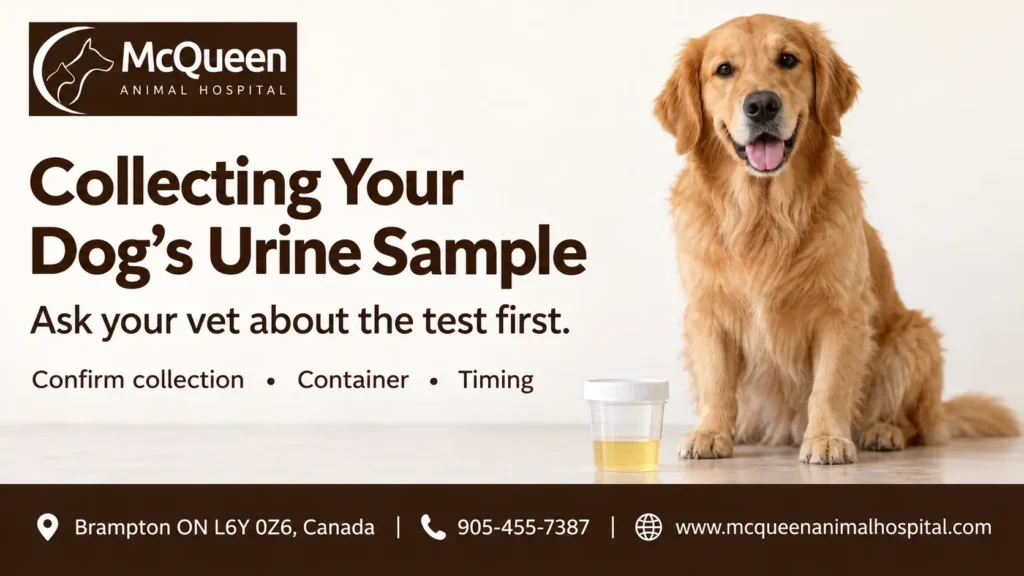
Before collecting a dog urine sample, confirm that the requested test accepts a sample caught at home. A home-collected sample can be useful for some urine tests, but other investigations need urine collected differently by the veterinary team. Ask which container to use, how much to collect, when to collect it and how quickly it must reach the clinic. These details can determine whether the sample provides useful results or needs to be collected again.
Why the required test determines the collection method
A free-catch sample is urine caught in a container while your dog urinates naturally. It avoids an invasive procedure and may be suitable for routine urinalysis, which assesses properties such as urine concentration, chemical findings and material examined under a microscope. However, urine passing out of the body can pick up bacteria and debris from the genital area, fur or surroundings.
That distinction matters particularly when the veterinarian needs a bacterial culture, a test that checks for bacterial growth. Contamination can make it harder to tell whether bacteria came from the urinary tract or entered the sample during collection. Cornell University’s urine culture submission guidance identifies cystocentesis—collection directly from the bladder by a veterinary professional—as providing the most accurate culture results. A free-catch sample may still be accepted in certain circumstances, but the veterinarian must choose the method and interpret the result accordingly.
Clinic collection is not one single method: the team may catch naturally passed urine or use a veterinary procedure, depending on the dog and the investigation. Catching urine in a sterile pot does not make a home sample sterile. If testing is being investigated because of increased thirst and urination in your dog, explain those changes to the requesting team rather than assuming a particular collection method will be suitable.
What to ask before collecting
Contact the clinic requesting the test before your planned collection. If you are searching for a “vet clinic near me” to arrange testing, establish which clinic will assess your dog and receive the sample before collecting it.
Have these questions ready:
- Does this test accept a home-collected, free-catch sample?
- Can you supply a specimen pot, and what collection equipment may I use?
- How much urine do you need?
- Do you want the first urine of the morning or a sample collected at another time?
- How soon must I deliver it, and what should I do if there is a delay?
- Does my dog need any specific preparation?
There is no single collection volume or storage window that suits every test. Tell the team if the planned drop-off time is several hours after collection, or if your dog usually passes only small amounts on walks. Do not restrict water, change medication or make your dog hold urine for an extended period to obtain a sample unless the treating veterinarian has given specific instructions.
McQueen’s pet pathology and diagnostic services page explains its broader laboratory services. For your dog’s urine test, ask the requesting team which collection and handling instructions apply.
Use the container and equipment the clinic approves
A clinic-supplied specimen pot with a secure screw lid is the simplest way to avoid uncertainty about the final container. Keep it closed until needed, and avoid touching the inside of the pot or lid. If catching urine directly in the pot would be difficult, ask whether a separate shallow collection tray or long-handled collector is acceptable and how it should be prepared.
Do not substitute a washed food jar or a household container without checking. The Merck Veterinary Manual’s guidance on preparing urine samples warns that reused containers can retain detergent that interferes with analysis. A container that looks clean is not necessarily suitable for laboratory testing.
Do not add water, disinfectant or preservatives. If the clinic supplies a special tube containing an additive, ask for its exact filling and handling instructions rather than treating it like an ordinary urine pot.
How to collect a dog urine sample at home
Once the clinic has approved home collection, prepare everything before taking your dog outside. Choose a familiar toilet area, keep your movements calm and use a lead if your dog is comfortable with one. A second person can manage the lead while you concentrate on the container, provided the extra attention does not unsettle your dog.
- Let your dog begin urinating naturally. Avoid repeatedly repositioning them or placing the container against their body.
- Catch part of the middle of the stream if practical. For a dog that squats, gently slide a shallow, approved collector beneath the stream without touching the ground or body. For a dog that lifts a leg, position the collector in the stream before the urine touches a surface.
- Collect the amount requested. Do not keep pursuing your dog to fill a large container. If you obtain less than requested, ask the clinic whether it is enough.
- Secure the sample promptly. If you used a separate collector, transfer the urine as instructed, avoiding contact with the inside of the specimen pot. Screw the lid on firmly and wash your hands.
Midstream collection reduces some contamination from material flushed out at the start of urination, but it does not eliminate contamination. The University of Minnesota’s veterinary diagnostic teaching guidance on urine collection explains both the reason for a midstream catch and the use of a suitable bowl or collector when direct collection is difficult.
Do not collect urine from grass, pavement, bedding or an absorbent pad. If the container touches faeces, soil or another dirty surface, or visible debris enters the sample, tell the clinic. Do not strain the urine, rinse the container while keeping the sample or combine separate attempts to increase the volume.
Label, store and transport the sample as instructed
Label the container with your dog’s name, your surname, the collection date and the exact collection time. Note that it was a home-collected free-catch sample, and tell the clinic about any contamination or handling problems. These details help the team judge the sample’s limitations rather than interpreting it as though it had been collected differently.
Freshness matters because urine continues to change after leaving the body. Cells can deteriorate, bacteria can multiply, and storage can affect chemical findings and crystals. The American Society for Veterinary Clinical Pathology’s urinalysis guidelines recommend prompt examination and refrigeration when immediate analysis is not possible, while recognising that stability varies with the sample’s composition. Refrigeration slows changes; it does not preserve every finding indefinitely.
For an ordinary, unpreserved sample, the clinic will commonly advise refrigeration if delivery is delayed. Confirm its instructions before collection, including the latest acceptable arrival time and whether the sample should remain cool during transport. Do not freeze it unless specifically instructed for the requested test, and do not assume an overnight sample will be acceptable.
Keep the tightly closed pot upright inside a separate sealed bag for transport, with any paperwork protected from leaks. Avoid leaving it in a warm car or direct sunlight. At handover, give the team the collection time and explain whether it was refrigerated and for how long. If your delivery plans change, call before bringing in an older sample.
If collection fails or your dog is uncomfortable
If your dog stops urinating when you approach, moves away or becomes worried, stop the attempt. Contact the requesting clinic to discuss another attempt or collection by the veterinary team. If a veterinary examination is already arranged, do not postpone it simply because you could not obtain the sample. Do not squeeze your dog’s abdomen or bladder, insert anything into the urinary opening or attempt catheterisation.
Straining to urinate is different from being reluctant to urinate with someone nearby. If your dog repeatedly strains, appears painful or passes only drops, seek veterinary advice promptly rather than waiting to collect a better sample. If your dog cannot pass urine, seek emergency veterinary care immediately; the American College of Veterinary Surgeons identifies inability to urinate as requiring immediate assessment.
If McQueen requested the sample, contact the clinic when collection or delivery does not go as planned. Explain what happened so the team can advise whether to bring what you have, try again or attend without a sample.
Medically reviewed by Dr. Harinder Babbar, DVM
Veterinarian & Medical Director
McQueen Animal Hospital, Brampton, OntarioThis article has been medically reviewed and is based on current evidence-based veterinary literature and clinical guidance.