
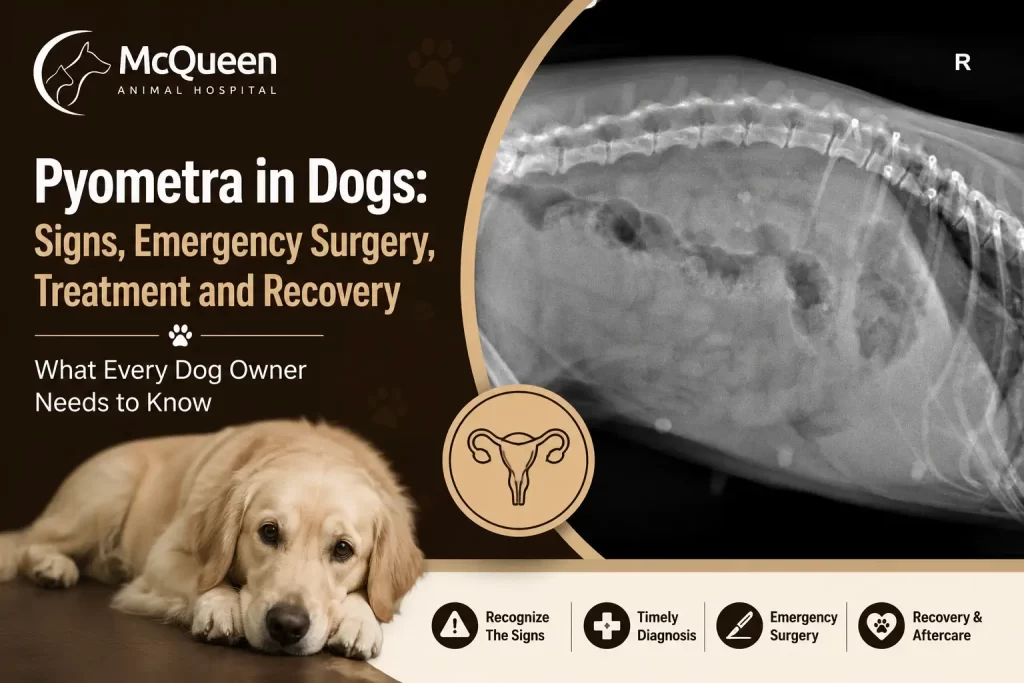
Pyometra in dogs is a bacterial infection of the uterus that fills the organ with pus and can become life-threatening within days if it goes untreated. It develops most often two to eight weeks after a heat cycle, when hormonal changes make the uterus more susceptible to bacteria.
Signs range from lethargy, vomiting and increased thirst to vaginal discharge, though some dogs show no discharge at all. Emergency surgery to remove the infected uterus and ovaries is the standard treatment, and dogs diagnosed and treated early generally recover well.
This guide covers the causes, symptoms, diagnosis, treatment and recovery process for pyometra in dogs, along with when to seek emergency veterinary care in Brampton.
Quick Facts About Pyometra in Dogs
- What it is: an infection and pus buildup in the uterus, primarily in unspayed female dogs
- When it happens: usually two to eight weeks after a heat cycle
- Warning signs: lethargy, increased thirst, vomiting, with or without vaginal discharge
- Treatment: emergency surgery to remove the infected uterus and ovaries
- Urgency: untreated pyometra can progress to sepsis, shock or uterine rupture
What Is Pyometra in Dogs?
Pyometra is a serious infection of the uterus that occurs primarily in unspayed female dogs. The uterus becomes infected and fills with inflammatory material and pus.
It is much more than a simple reproductive tract infection.
Bacteria and bacterial toxins can enter the bloodstream, potentially leading to dehydration, kidney dysfunction, systemic inflammatory response, sepsis, shock and, in severe cases, death.
For this reason, pyometra should be considered a potentially life-threatening veterinary emergency.
Fortunately, when pyometra is recognized promptly and treated appropriately, many dogs can recover successfully.
The most important message for dog owners is:
An unspayed female dog that becomes sick—particularly during the weeks following a heat cycle—should be evaluated promptly for pyometra.
Why Does Pyometra Develop?
Pyometra develops because of the interaction between reproductive hormones and bacteria.
During each heat cycle, a female dog’s reproductive tract undergoes hormonal changes in preparation for a possible pregnancy.
After estrus, the hormone progesterone remains elevated for several weeks.
Progesterone causes several changes within the uterus:
- The uterine lining becomes thicker.
- Uterine glands become more active.
- The uterus becomes more suitable for supporting pregnancy.
- Uterine contractions decrease.
- Local immune defenses within the uterus are altered.
These changes are normal when pregnancy occurs.
However, repeated hormonal exposure over multiple heat cycles can lead to changes within the uterine lining that create an environment in which bacteria can grow more easily.
This is one reason pyometra is seen more commonly in middle-aged and older intact female dogs, although younger dogs can also develop the disease.
Where Do the Bacteria Come From?
The uterus is normally protected from bacterial contamination.
During a dog’s heat cycle, however, the cervix opens, allowing sperm to enter the reproductive tract if mating occurs.
Unfortunately, bacteria can also ascend through the cervix.
The organism most frequently isolated from canine pyometra is Escherichia coli (E. coli), a bacterium commonly present in the intestinal and genital regions.
Once bacteria enter a hormonally influenced uterus, they may multiply rapidly.
The result can be a uterus containing a substantial amount of infected fluid or pus.
When Does Pyometra Usually Occur?
Pyometra most commonly develops during diestrus, the hormonal phase following a heat cycle.
Many cases occur approximately 2–8 weeks after estrus, although timing can vary.
This history can provide an important clue.
If an intact female dog was in heat several weeks ago and subsequently becomes:
- Lethargic
- Less interested in food
- Excessively thirsty
- Vomiting
- Unwell
- Or develops vaginal discharge
pyometra should be considered.
Owners sometimes forget that their dog’s heat cycle occurred several weeks earlier, so mentioning the date of the last known heat can be extremely helpful during the veterinary examination.
Which Dogs Are at Risk of Pyometra?
Any sexually intact female dog can potentially develop pyometra.
Risk generally increases with age and repeated heat cycles.
Dogs at increased risk include:
- Middle-aged and older unspayed females
- Dogs that have undergone many heat cycles
- Dogs that have never been bred
- Dogs previously treated with certain reproductive hormones
- Dogs with previous uterine disease
However, being young does not completely eliminate the possibility.
Pyometra can occasionally occur in younger intact dogs.
What Are the Signs of Pyometra in Dogs?
The signs can vary considerably depending on how advanced the infection is and whether the cervix is open or closed.
Common symptoms include:
- Lethargy
- Reduced appetite
- Increased thirst
- Increased urination
- Vomiting
- Vaginal discharge
- Fever
- Abdominal enlargement
- Abdominal discomfort
- Weakness
- Dehydration
- Panting
- Weight loss
- Diarrhea in some dogs
Severely affected dogs may become extremely weak, collapse or develop signs of shock.
One particularly important combination is:
An intact female dog + recent heat cycle + increased drinking + lethargy or vaginal discharge.
That combination warrants prompt veterinary assessment.
Why Do Dogs With Pyometra Often Drink and Urinate More?
Increased thirst and urination are common signs of pyometra.
Bacterial toxins circulating in the bloodstream can interfere with the kidneys’ ability to concentrate urine normally.
The dog therefore produces larger volumes of dilute urine and compensates by drinking more water.
Owners may notice that their dog:
- Empties the water bowl unusually quickly
- Asks to go outside more frequently
- Produces larger amounts of urine
- Begins having urinary accidents indoors
These signs can easily be mistaken for kidney disease, diabetes or a urinary tract infection.
In an intact female dog, however, pyometra should also be considered.
Open Pyometra vs. Closed Pyometra
Pyometra is commonly classified as either open-cervix or closed-cervix pyometra.
Understanding the difference is important.
Open Pyometra
With open pyometra, the cervix remains sufficiently open to allow infected uterine material to drain through the vagina.
Owners may notice:
- Cream-coloured discharge
- Yellow or green discharge
- Brown discharge
- Blood-tinged discharge
- Foul-smelling discharge
Some dogs repeatedly lick themselves, so the discharge may not be immediately obvious.
The presence of discharge can make open pyometra easier to recognize.
However:
An open pyometra is still a serious infection and should not be considered safe simply because the uterus is draining.
The dog can still develop systemic illness, dehydration, kidney abnormalities, and sepsis.
Closed Pyometra
Closed pyometra can be particularly dangerous because the cervix is closed and infected material cannot drain externally.
Pus continues accumulating inside the uterus.
The uterus may become substantially enlarged and fragile.
Because there may be no vaginal discharge, owners may not realize that the reproductive tract is the source of illness.
Signs may include:
- Severe lethargy
- Loss of appetite
- Vomiting
- Increased thirst
- Increased urination
- Enlarged or painful abdomen
- Weakness
- Rapid deterioration
- Collapse
A severely distended infected uterus can potentially rupture, releasing contaminated material into the abdominal cavity and causing septic peritonitis.
Closed pyometra therefore requires particularly urgent attention.
Can a Dog Have Pyometra Without Vaginal Discharge?
Absolutely.
This is one of the most important misconceptions about pyometra.
Owners sometimes assume that pyometra always causes obvious pus or bloody discharge from the vulva.
That is not true.
In closed-cervix pyometra, there may be no discharge at all.
The dog may simply appear:
- Tired
- Thirsty
- Off food
- Vomiting
- Weak
- Or generally unwell
Therefore, the absence of vaginal discharge does not rule out pyometra.
How Quickly Can Pyometra Become Serious?
The clinical course varies.
Some dogs initially appear only mildly unwell, while others deteriorate rapidly.
As infection progresses, bacterial toxins and inflammatory mediators can affect multiple organs.
Possible consequences include:
- Severe dehydration
- Electrolyte abnormalities
- Kidney dysfunction
- Systemic inflammatory response syndrome
- Sepsis
- Low blood pressure
- Abnormal blood clotting
- Shock
- Uterine rupture
- Septic peritonitis
This is why waiting several days to see whether an intact female dog’s symptoms improve can be dangerous when pyometra is a possibility.
How Is Pyometra Diagnosed?
Diagnosis begins with the dog’s history and physical examination.
Important questions include:
- Is the dog spayed?
- When was her last heat?
- Has she been drinking more?
- Is she urinating more?
- Has her appetite changed?
- Has she vomited?
- Has vaginal discharge been noticed?
- Has her abdomen enlarged?
- Has she received reproductive hormone medications?
The veterinarian will also evaluate:
- Hydration
- Temperature
- Heart rate
- Respiratory rate
- Abdominal comfort
- Vulvar discharge
- Circulatory status
- Overall degree of illness
Diagnostic testing is then used to confirm the suspicion and assess how severely the dog has been affected.
Bloodwork in Dogs With Pyometra
Blood testing is important because pyometra is not simply a disease of the uterus—it can affect the entire body.
Testing commonly includes:
Complete Blood Count (CBC)
The CBC evaluates:
- White blood cells
- Red blood cells
- Platelets
Many dogs with pyometra have significant changes in their white blood cell count because of infection and inflammation.
However, the degree and direction of the change can vary.
A severely ill dog may occasionally have a low rather than high white blood cell count, which can be particularly concerning.
Serum Chemistry
A chemistry panel helps evaluate:
- Kidney function
- Liver values
- Blood glucose
- Proteins
- Electrolytes
- Other metabolic abnormalities
Kidney values deserve particular attention because dehydration and bacterial toxins can affect renal function.
Does My Dog Need a Urine Test?
Urinalysis may provide additional information about:
- Urine concentration
- Kidney function
- Evidence of urinary tract disease
- Other abnormalities
Because increased thirst and urination can occur with several diseases, urine testing can contribute to the overall assessment.
How Does Ultrasound Help Diagnose Pyometra?
Abdominal ultrasound is particularly useful when pyometra is suspected.
A normal uterus is usually relatively small and may be difficult to visualize.
With pyometra, ultrasound may reveal enlarged tubular uterine horns containing fluid.
Depending on the case, the veterinarian may identify:
- Enlarged uterine horns
- Fluid within the uterus
- Thickened uterine walls
- Changes in surrounding abdominal tissues
- Evidence of other reproductive abnormalities
Ultrasound can be especially valuable in a dog with closed pyometra, where no vaginal discharge is present.
What About X-Rays?
Abdominal radiographs may also reveal an enlarged, fluid-filled tubular structure consistent with an enlarged uterus.
However, ultrasound generally provides more detailed information about the uterine contents and structure.
X-rays may still be useful depending on the individual patient and available diagnostic information.
What Is the Treatment for Pyometra?
For most dogs with pyometra, the treatment of choice is:
Surgical removal of the infected uterus and ovaries.
This procedure is an ovariohysterectomy—the same organs removed during a routine spay—but pyometra surgery is not equivalent to a routine spay.
The patient may already be systemically ill, and the uterus may be:
- Enlarged
- Inflamed
- Filled with infected material
- Fragile
- At risk of tearing
Consequently, pyometra surgery requires careful stabilization, anesthesia, surgical handling and postoperative monitoring.
Why Is Pyometra Surgery More Complicated Than a Routine Spay?
During a routine elective spay, the reproductive tract is generally healthy.
During pyometra surgery, the surgeon may encounter a uterus that is dramatically enlarged and filled with pus.
Important differences include:
- The uterus may be much larger than normal.
- Uterine tissue can be fragile.
- Blood vessels may be enlarged.
- The abdomen may require a larger incision.
- Manipulation must be careful to avoid rupture or leakage.
- The dog may already be dehydrated or septic.
- Anesthetic risk may be greater.
- Intravenous fluids and antibiotics are commonly required.
- Hospitalization and monitoring may be more intensive.
The surgical objective is to remove the ovaries and infected uterus without allowing contaminated uterine contents to leak into the abdomen.
Stabilization Before Pyometra Surgery
Some dogs can proceed to surgery relatively quickly.
Others require stabilization first.
Depending on the patient’s condition, treatment before surgery may include:
- Intravenous catheter placement
- IV fluids
- Antibiotics
- Pain medication
- Anti-nausea medication
- Correction of electrolyte abnormalities
- Blood-pressure support
- Additional treatment for shock or systemic illness
The objective is not necessarily to make every blood value normal before surgery.
The goal is to improve cardiovascular stability and reduce anesthetic risk sufficiently to remove the source of infection safely.
Because the infected uterus remains the underlying problem, surgery should generally not be delayed unnecessarily once the patient is appropriately stabilized.
What Happens During Pyometra Surgery?
After the dog is anesthetized and the abdomen is surgically prepared, an abdominal incision is made.
The surgeon identifies the enlarged uterus and carefully exteriorizes it.
Because the uterus can be large and fragile, it must be handled gently.
The ovarian pedicles and uterine blood supply are securely ligated, and the ovaries and infected uterus are removed.
Before closing the abdomen, the surgical area is assessed for:
- Bleeding
- Leakage
- Evidence of uterine rupture
- Contamination
- Other abnormalities
If infected uterine material has leaked into the abdomen, additional lavage and treatment may be required.
The abdominal incision is then closed in appropriate tissue layers.
What If the Uterus Has Already Ruptured?
Uterine rupture makes the situation considerably more serious.
When infected material escapes into the abdominal cavity, the dog can develop septic peritonitis.
Treatment may require:
- Emergency abdominal surgery
- Removal of the infected reproductive tract
- Extensive abdominal lavage
- IV antibiotics
- Aggressive fluid therapy
- Intensive monitoring
- Blood-pressure support
- Longer hospitalization
The prognosis becomes more guarded when rupture, severe sepsis or organ dysfunction is present.
This is another reason early diagnosis is so important.
Can Pyometra Be Treated Without Surgery?
Medical treatment is possible in carefully selected cases, but it is not appropriate for most pet dogs with pyometra.
Medical management may sometimes be considered for a valuable breeding dog when:
- The cervix is open
- The patient is systemically stable
- There is no evidence of uterine rupture
- Future fertility is important
- The owner understands the risks
- Intensive veterinary monitoring is available
Treatment may involve medications that alter progesterone activity and stimulate uterine evacuation.
However, medical treatment has important disadvantages:
- It does not immediately remove the infected uterus.
- The dog can deteriorate during treatment.
- Treatment may fail.
- Pyometra can recur after future heat cycles.
- Emergency surgery may still become necessary.
For a systemically ill dog, a closed pyometra, a dog not intended for breeding, or a patient with complications, surgery is generally the preferred definitive treatment.
Are Antibiotics Alone Enough?
Usually, no.
Antibiotics are an important component of pyometra treatment, particularly when systemic infection is suspected.
But antibiotics alone generally do not solve the underlying problem: a diseased, infected uterus containing fluid and pus.
Even if a dog temporarily appears better after antibiotics, infection may persist or recur.
For most affected pet dogs, definitive treatment requires removal of the infected reproductive tract.
Is an Older Dog Too Old for Pyometra Surgery?
No specific age automatically makes a dog too old for surgery.
Pyometra commonly occurs in older dogs, so many affected patients are seniors.
The more appropriate questions are:
- How sick is this dog?
- Is she dehydrated?
- Is she septic?
- Are the kidneys functioning adequately?
- Does she have significant heart disease?
- Has the uterus ruptured?
- Can her condition be stabilized sufficiently for anesthesia?
An older dog with otherwise reasonable organ function may still be an appropriate surgical candidate.
Conversely, a younger dog with severe sepsis and shock can carry substantial anesthetic risk.
Physiological condition matters more than chronological age alone.
What If My Dog Has a Heart Murmur?
A heart murmur does not automatically mean that surgery cannot be performed.
Its significance depends on:
- The underlying cardiac disease
- Severity of disease
- Evidence of congestive heart failure
- Blood pressure
- Overall cardiovascular stability
- Urgency of the pyometra
Additional cardiac assessment may be recommended when clinically appropriate.
However, pyometra itself can become fatal if the infected uterus remains untreated. The veterinarian must therefore balance anesthetic risk against the potentially greater risk of leaving a serious infection in place.
Treatment decisions should be individualized.
What Is Recovery Like After Pyometra Surgery?
Recovery depends greatly on how ill the dog was before surgery.
A relatively stable dog treated early may recover much like a patient undergoing other abdominal surgery.
A dog with severe infection, kidney abnormalities, low blood pressure or uterine rupture may require considerably more intensive postoperative care.
After surgery, treatment may include:
- IV fluids
- Antibiotics
- Pain medication
- Anti-nausea medication
- Monitoring temperature
- Monitoring blood pressure
- Monitoring urine production
- Repeat bloodwork when indicated
- Incision monitoring
Some dogs can go home relatively soon after surgery, while severely affected dogs may require longer hospitalization.
General Recovery Timeline After Pyometra Surgery
First 24 Hours
Your dog may remain tired following anesthesia and systemic illness.
The veterinary team monitors:
- Cardiovascular stability
- Pain
- Hydration
- Temperature
- Appetite
- Urination
- Surgical incision
Days 2–3
Many dogs treated before severe complications develop begin showing improvement in appetite, energy and hydration.
Dogs that were septic may recover more slowly.
Days 4–7
Activity should remain restricted.
The incision should stay clean and dry, and licking must be prevented.
Days 10–14
Many uncomplicated surgical incisions have substantially healed.
A postoperative examination may be recommended, and external sutures or staples may be removed if applicable.
After Two Weeks
Many dogs can gradually return to normal activity after veterinary approval.
Internal recovery continues even when the skin incision looks healed.
What Complications Can Occur After Pyometra Surgery?
Most dogs treated appropriately recover successfully, but complications can occur.
Potential problems include:
- Sepsis
- Low blood pressure
- Kidney dysfunction
- Abnormal heart rhythms
- Bleeding
- Peritonitis
- Wound infection
- Incisional complications
- Persistent vomiting or poor appetite
- Blood-clotting abnormalities
- Rarely, death despite treatment
Risk generally increases when treatment is delayed or when the dog presents with severe systemic illness, shock or uterine rupture.
What Is the Prognosis for a Dog With Pyometra?
The prognosis is generally good when pyometra is diagnosed and surgically treated before severe systemic complications develop.
Many dogs recover completely after removal of the infected uterus and ovaries.
Prognosis becomes more guarded when complications include:
- Septic shock
- Uterine rupture
- Septic peritonitis
- Significant kidney dysfunction
- Severe dehydration
- Abnormal clotting
- Persistent low blood pressure
- Multiple-organ dysfunction
The condition of the dog at presentation therefore has a major influence on outcome.
This is why early veterinary assessment can make such an important difference.
Can Pyometra Come Back After Surgery?
After a complete ovariohysterectomy in which the ovaries and uterus are appropriately removed, traditional uterine pyometra cannot recur because the uterus is no longer present.
Rare reproductive tract infections associated with ovarian remnant or uterine stump tissue can occur, but these are different situations.
Definitive pyometra surgery therefore both treats the current disease and prevents future uterine pyometra.
Can Pyometra Be Prevented?
Yes.
The most reliable prevention is spaying.
Removing the ovaries and uterus prevents the hormonal uterine changes responsible for conventional pyometra.
This is an important health benefit of spaying that sometimes receives less attention than prevention of unwanted pregnancy.
For owners who intentionally keep a female dog intact, awareness is particularly important.
Monitor your dog carefully following every heat cycle and seek veterinary attention if you notice:
- Increased thirst
- Increased urination
- Lethargy
- Reduced appetite
- Vomiting
- Vaginal discharge
- Abdominal enlargement
- Unexplained illness
Does Having Puppies Prevent Pyometra?
No.
A common misconception is that a female dog should have one litter because pregnancy somehow protects the uterus.
Having puppies does not eliminate the future risk of pyometra.
An intact female continues undergoing reproductive hormonal cycles after pregnancy and can develop pyometra later in life.
There is no medical requirement for a dog to have a litter before being spayed.
Does My Dog Need to Be Spayed If She Has Already Had Pyometra?
For most pet dogs, surgical treatment of pyometra itself involves removal of the ovaries and infected uterus.
Therefore, the dog becomes spayed as part of the definitive treatment.
This eliminates future heat cycles, pregnancy and conventional uterine pyometra.
When Should I Seek Emergency Veterinary Care?
An intact female dog should receive prompt veterinary assessment if she develops unexplained illness, particularly during the weeks following a heat cycle.
Seek urgent attention for:
- Severe lethargy
- Repeated vomiting
- Refusal to eat
- Markedly increased thirst
- Vaginal pus or abnormal discharge
- Swollen or painful abdomen
- Weakness
- Pale gums
- Collapse
- Difficulty standing
- Rapid deterioration
Do not wait for vaginal discharge to appear.
Closed pyometra may produce no discharge at all.
My Dog Was in Heat Recently and Is Drinking More—What Should I Do?
Increased thirst can have many causes, including kidney disease, diabetes and hormonal disorders.
However, in an unspayed female dog that was in heat within the previous several weeks, increased thirst deserves particular attention because it can be an early sign of pyometra.
If increased drinking is accompanied by lethargy, reduced appetite, vomiting, vaginal discharge or increased urination, arrange a veterinary examination promptly.
What Happens If Pyometra Is Left Untreated?
Untreated pyometra can progress from a localized uterine infection to systemic disease.
Possible progression includes:
Infected uterus → bacterial toxins and inflammation → dehydration and organ dysfunction → sepsis → shock → possible uterine rupture and peritonitis.
The disease does not reliably resolve on its own.
A dog that appears reasonably stable in the morning can potentially become significantly more ill as infection progresses.
For that reason, suspected pyometra should not be managed with prolonged observation at home.
Pyometra Diagnosis and Surgery in Brampton
At McQueen Animal Hospital in Brampton, we evaluate intact female dogs with signs that may indicate pyometra and develop an individualized treatment plan based on the patient’s clinical condition.
Depending on the dog, evaluation and treatment may include:
- Complete physical examination
- CBC and serum chemistry
- Urinalysis when indicated
- Abdominal X-rays
- Abdominal ultrasound
- IV catheterization and fluid therapy
- Antibiotics
- Pain management
- Anesthetic assessment
- Surgical removal of the infected uterus and ovaries
- Postoperative monitoring and supportive care
- Follow-up examination
Our objective is not simply to perform surgery. We first assess how significantly the infection has affected the patient, stabilize the dog when necessary, remove the source of infection and provide appropriate postoperative support.
If your unspayed female dog has recently been in heat and develops lethargy, increased thirst, vomiting, loss of appetite or vaginal discharge, do not wait for the symptoms to become severe.
Call McQueen Animal Hospital at 905-455-7387 for veterinary assessment.
Frequently Asked Questions About Pyometra in Dogs
Is pyometra an emergency?
Yes. Pyometra is a potentially life-threatening uterine infection that can progress to sepsis, shock or uterine rupture. Prompt veterinary assessment is recommended.
How long after a heat cycle does pyometra occur?
Many cases occur approximately 2–8 weeks after a heat cycle, although the timing can vary.
Can a young dog develop pyometra?
Yes. Pyometra is more common in middle-aged and older intact dogs but can occur in younger females.
Can my dog have pyometra without discharge?
Yes. Closed-cervix pyometra may produce no vaginal discharge whatsoever.
What does pyometra discharge look like?
It may be cream-coloured, yellow, green, brown, bloody or foul smelling. Some dogs lick away the discharge before owners notice it.
Why is my dog drinking so much water?
Bacterial toxins and systemic illness associated with pyometra can impair the kidneys’ ability to concentrate urine, resulting in increased urination and compensatory thirst.
How is pyometra confirmed?
Diagnosis usually involves history, physical examination, bloodwork and imaging. Abdominal ultrasound is particularly useful for identifying an enlarged fluid-filled uterus.
Is ultrasound necessary?
Not every patient requires exactly the same tests, but ultrasound is extremely useful when pyometra is suspected, particularly in closed-cervix cases.
Can antibiotics cure pyometra?
Antibiotics are important but are generally not sufficient as the sole treatment for pyometra in most pet dogs.
What is the best treatment for pyometra?
For most affected dogs, surgical removal of the ovaries and infected uterus is the definitive treatment.
Is pyometra surgery the same as a normal spay?
The same reproductive organs are removed, but pyometra surgery is usually more complex because the uterus is infected, enlarged and potentially fragile, and the dog may already be systemically ill.
Can the infected uterus burst?
Yes. A severely diseased uterus can rupture, potentially causing septic peritonitis and making the condition substantially more dangerous.
Can pyometra be treated medically?
Medical management may be considered in carefully selected breeding dogs under close veterinary supervision. It is not the preferred treatment for most pet dogs, particularly those that are systemically ill.
Can an older dog survive pyometra surgery?
Yes. Many senior dogs recover successfully. Overall health and severity of illness are more important than chronological age alone.
Can a dog with a heart murmur have pyometra surgery?
Potentially, yes. A heart murmur does not automatically prohibit anesthesia. The cardiovascular condition, severity of pyometra and urgency of treatment must be assessed individually.
How long does pyometra surgery take to recover from?
Initial incision healing commonly takes around 10–14 days, although dogs that were severely ill before surgery may require longer overall recovery.
Will my dog need antibiotics after surgery?
Many dogs receive antibiotics, but the specific medication and duration depend on the severity of infection and individual clinical findings.
Can pyometra return after surgery?
After complete removal of the ovaries and uterus, conventional uterine pyometra cannot recur.
Can spaying prevent pyometra?
Yes. Spaying is the most reliable method of preventing conventional pyometra.
Does having one litter prevent pyometra?
No. Having puppies does not eliminate the risk of developing pyometra later.
What is the prognosis?
Most dogs treated surgically before severe complications develop have a good prognosis. The outlook becomes more guarded with septic shock, uterine rupture, peritonitis or significant organ dysfunction.
What is the most important thing an owner should remember about pyometra?
If an unspayed female dog becomes ill—especially within several weeks after a heat cycle—do not wait for vaginal discharge before seeking veterinary care. Closed pyometra can occur without any discharge and can become life-threatening.
Medical Review
Medically reviewed by Dr. Harinder Babbar, DVM
Veterinarian & Medical Director
McQueen Animal Hospital, Brampton, Ontario
This article has been medically reviewed and is based on current evidence-based veterinary literature and clinical guidance.